

Trying to prepare a legal brief from inside a United States correctional facility often feels overwhelming. Limited access to legal resources and confusing procedures can make the process seem out of reach. By breaking the work into clear steps—like collecting the right documents, applying professional formatting, and following court-specific rules—you gain better control over your case. Focusing on precise legal material collection and clear organization is your starting point for building a strong and credible brief.
Table of Contents
- Step 1: Gather Required Legal Materials
- Step 2: Set Up Document Formatting Basics
- Step 3: Apply Court-Specific Formatting Rules
- Step 4: Insert Proper Citations and References
- Step 5: Review and Finalize Your Legal Brief
Quick Summary
| Key Point | Explanation |
|---|---|
| 1. Gather Essential Legal Materials | Compile judicial opinions, statutes, court records, and precedents to substantiate your legal argument effectively. |
| 2. Follow Standard Document Formatting | Use 8.5 x 11 paper, Times New Roman font, double spacing, and proper page numbering to present a professional brief. |
| 3. Adhere to Court-Specific Rules | Research unique formatting requirements for your court to avoid rejection or delays in your legal brief submission. |
| 4. Accurately Cite Legal Sources | Use The Bluebook or your jurisdiction’s citation manual for precise legal citations, ensuring reliability of your arguments. |
| 5. Conduct a Thorough Review | Check for formatting consistency, argument clarity, and grammatical correctness, considering an external review for additional insight. |
Step 1: Gather Required Legal Materials
Preparing a legal brief starts with meticulous material collection. Your goal is to compile all essential documents that will form the foundation of your legal argument. This means tracking down primary legal sources that substantiate your case.
Begin by identifying and collecting key legal documents, which typically include comprehensive case records. Focus on gathering judicial opinions, statutes, court records, and any precedent-setting decisions relevant to your specific legal issue. Read through each document carefully, extracting critical facts, legal principles, and procedural history that will strengthen your brief.
Organize these materials systematically. Create a chronological timeline of events, highlight key passages, and note page numbers where important legal arguments are found. Annotate your documents thoroughly, making connections between different sources and identifying how they support your legal position. This preparation will make drafting your brief significantly more efficient and focused.
Here’s a summary of common legal documents and how each contributes to your brief:
| Document Type | Main Purpose | Typical Content |
|---|---|---|
| Judicial Opinions | Establishes precedent | Judge’s reasoning, decision, cited authorities |
| Statutes | Sets out applicable law | Legislative texts, definitions, requirements |
| Court Records | Provides procedural background | Filings, orders, dockets, prior motions |
| Precedent Decisions | Supports or contrasts legal arguments | Case citations, outcome, fact patterns |
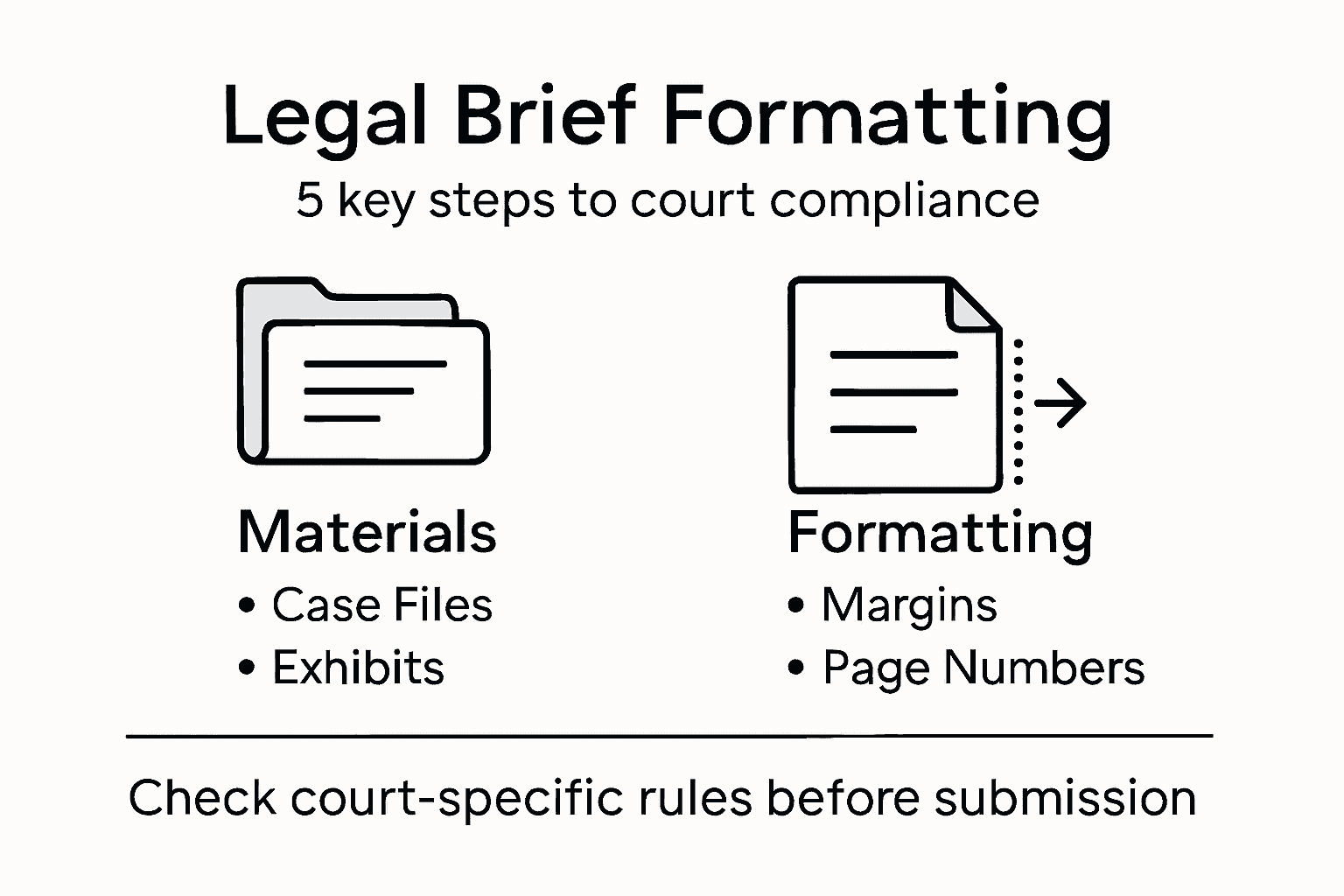
Pro Tip: Create a dedicated folder or digital file for your legal materials, using a consistent naming convention that allows you to quickly locate specific documents during the drafting process.
Step 2: Set Up Document Formatting Basics
Preparing a professional legal brief requires precise document formatting that meets strict court standards. Your first objective is to establish a clean, uniform layout that ensures your document looks polished and adheres to judicial guidelines.
Start by configuring your document using standard legal formatting guidelines. Use 8.5 by 11-inch paper with one-inch margins on all sides. Select a professional font like Times New Roman at 12-point size, which remains the most widely accepted in legal documentation. Ensure your entire document uses double line spacing to improve readability and provide space for potential judicial annotations or markups.

Pay close attention to page numbering, header placement, and consistent paragraph formatting. Most courts expect page numbers centered at the bottom of each page and headers that include the document title or case reference. Maintain consistent alignment throughout your brief typically using left justification. These seemingly small details demonstrate your professionalism and respect for judicial formatting protocols.
Pro Tip: Create a document template with these exact formatting specifications to save time on future legal briefs and ensure consistent presentation.
Step 3: Apply Court-Specific Formatting Rules
Navigating court-specific formatting rules requires precision and attention to detail. Each court has unique requirements that can make or break your legal brief’s acceptance, so understanding these nuanced guidelines is crucial for your submission.
Review the federal appellate formatting regulations carefully to ensure compliance. Different courts mandate specific details like cover page color, font restrictions, and precise page layout. For instance, appellate courts often require color-coded covers that indicate which party is filing the brief. Pay close attention to font size, line spacing, margin width, and even the type of paper you use. Some courts have extremely specific requirements about paper weight, binding method, and document length.
Research the exact formatting rules for the specific court where you will file your brief. While general formatting principles are similar, each jurisdiction may have unique specifications. Contact the court clerk or review the court’s local rules if you are uncertain about any formatting requirement. Missing even a small detail could result in your brief being rejected or returned, potentially delaying your legal proceedings.
Compare how general formatting requirements differ from court-specific rules:
| Feature | General Standard | Court-Specific Examples |
|---|---|---|
| Paper Size | 8.5 x 11 inches | Some courts specify heavier paper stock |
| Cover Page | Standard title and info | Appellate courts may require colored covers |
| Font | Times New Roman, 12-point | Some restrict to specific fonts or sizes |
| Document Length | No hard limit | Strict page or word limits by some courts |
Pro Tip: Create a detailed checklist of formatting requirements for each specific court to ensure you do not overlook any critical formatting details.
Step 4: Insert Proper Citations and References
Citing legal sources accurately is a critical skill that can make or break the credibility of your legal brief. Your citations serve as the foundation of your legal argument, providing concrete support for every claim and assertion you make.
Master the legal citation standards by using The Bluebook or your jurisdiction’s specific citation manual. Each citation must include precise information: the case name, volume number, reporter abbreviation, page number, and year of decision. Pay special attention to pinpoint citations that direct readers to the exact page or paragraph supporting your argument. Ensure you use consistent formatting throughout your document, being meticulous about punctuation, italicization, and abbreviations.
Create a comprehensive table of authorities that lists all sources alphabetically and by type. This not only helps the court quickly reference your sources but also demonstrates your attention to detail and professional approach to legal writing. Double-check every citation for accuracy, as even minor errors can undermine the perceived reliability of your legal arguments.
Pro Tip: Use legal citation software or a detailed checklist to verify each citation meets the specific formatting requirements of your target court.
Step 5: Review and Finalize Your Legal Brief
Reviewing your legal brief is the critical final stage that determines whether your document will be accepted by the court. Your goal is to transform your draft into a polished professional document that meets all judicial standards.
Apply comprehensive legal writing review techniques methodically. Start by checking formatting consistency second by checking logical flow and argument coherence. Verify that each paragraph supports your legal argument, eliminating any redundant or unclear language. Scrutinize your citations to confirm they are precise and correctly formatted. Read your brief aloud to catch grammatical errors and awkward phrasings that might distract from your core legal arguments.
Consider requesting an external review from another legal professional or someone with strong writing skills. A fresh set of eyes can identify potential weaknesses in your reasoning or presentation that you might have overlooked. Pay special attention to the introduction and conclusion paragraphs, ensuring they clearly articulate your legal position and create a compelling narrative for the court.
Pro Tip: Create a final review checklist with specific items to examine so you do not miss any critical details during your document evaluation.
Ensure Your Legal Brief Meets Every Court Requirement with Expert Help
Formatting a legal brief to match strict court compliance rules can be overwhelming. The article highlights challenges like organizing complex legal materials, following both general and court-specific formatting guidelines, and perfecting citations to avoid costly errors or rejections. If you are incarcerated or representing yourself, these hurdles become even tougher when access to legal resources is limited. Proper formatting and detailed court-specific compliance are critical for your brief to be accepted and to effectively present your case.
At Prisoner Legal Aid, we understand these pain points and specialize in assisting clients exactly like you. From creating properly formatted federal and state court briefs to ensuring every citation and procedural detail aligns with court standards, our professional legal document preparation services take the stress out of this complex process. Take advantage of our affordable and confidential solutions designed for incarcerated individuals and self-represented litigants. Visit our main page to explore how we can help you prepare and submit your documents correctly the first time.
Don’t let formatting mistakes delay your case or undermine your arguments. Get the professional support you need now. Contact Prisoner Legal Aid for expert legal document preparation that helps you confidently meet all court requirements.
Frequently Asked Questions
What are the key legal materials required for a legal brief?
To prepare a legal brief, gather essential documents such as judicial opinions, statutes, court records, and precedent-setting decisions relevant to your case. Start by creating a dedicated folder for these materials and organizing your documents chronologically to streamline the drafting process.
How should I format my legal brief to meet court standards?
Your legal brief should be formatted on 8.5 by 11-inch paper with one-inch margins, using Times New Roman in 12-point size, and double line spacing. Set up a template with these specifications to ensure consistency and save time in future briefs.
What specific formatting rules do different courts have for legal briefs?
Formatting rules can vary significantly by court, including requirements for cover page color, page layout, and binding methods. Research the specific court’s local rules to ensure that your brief adheres to their unique requirements, as missing details can result in rejection.
How do I accurately cite legal sources in my brief?
Accurate citation involves using The Bluebook or your jurisdiction’s citation manual to include all necessary details like case name, volume number, reporter abbreviation, and page number. Create a table of authorities that lists all sources alphabetically to enhance the brief’s organization and credibility.
What steps should I take to review and finalize my legal brief?
To finalize your legal brief, check for formatting consistency, logical flow, and the accuracy of your citations. Read your draft aloud and consider having another legal professional review it to catch errors or weaknesses before submission.