

Filing your own legal documents can feel like every word is under a microscope. In Federal and State courts, the stakes are high and even small mistakes in language or format can mean rejection or dismissal. Understanding legal drafting is the precise craft of writing binding legal text that governs your rights and obligations, not general storytelling or casual writing. This article explains the difference, debunks common myths, and gives you clear guidance so your filings are strong, clear, and ready for court review.
Table of Contents
- Defining Legal Drafting and Common Myths
- Key Types of Legal Documents Used in Court
- Essential Qualities of Effective Legal Drafting
- Legal Requirements and Procedural Compliance
- Risks, Common Errors, and How to Avoid Them
Key Takeaways
| Point | Details |
|---|---|
| Understanding Legal Drafting | Legal drafting requires precise language to create enforceable rights and duties; clarity is essential. |
| Importance of Document Types | Different legal documents serve specific purposes and follow distinct formatting rules; knowing these is crucial for compliance. |
| Four Pillars of Effective Drafting | Clarity, precision, consistency, and organization are essential for effective legal documents to avoid confusion. |
| Avoiding Common Errors | Careless ambiguities, inconsistent terms, and procedural missteps can lead to case dismissals; rigorous review can prevent these mistakes. |
Defining Legal Drafting and Common Myths
When you file a legal document in court, every word matters. Legal drafting is the precise craft of writing binding legal text that creates enforceable rights and duties. This is not the same as general writing, and it is certainly not the same as storytelling. As an incarcerated person preparing your own legal documents, you need to understand this distinction because federal and state courts will scrutinize every sentence you submit. Legal drafting specifically focuses on crafting precise language that governs your rights and obligations, whether you are filing a habeas corpus petition, a civil rights complaint, or an appeal. Think of it this way: a writer tells a story, but a legal drafter constructs a mechanism. Your motion has to work. It has to operate correctly in the court system, just like an engine has to operate correctly to move a vehicle.
People often confuse legal drafting with other types of legal writing. They mistakenly believe that using complicated vocabulary or flowery language makes their documents more convincing. This is false, and it actually hurts your case. Courts care about clarity. When you use simple, direct language and precise word choice, you reduce the chance that a judge will misinterpret your argument. The opposite is true with complex language. Ambiguous wording creates confusion, and confusion leads to dismissals. Clarity and simplicity are vital to ensure your documents work as intended and reduce the risk of misunderstanding. This principle applies whether you are in a federal facility or a state prison, whether you are representing yourself in a § 1983 civil rights case or filing for sentence reduction. The judge does not want to guess what you meant. Say what you mean. Say it plainly.
Another common myth is that legal drafting is primarily concerned with describing situations or telling the judge what happened to you. That is narrative writing. Legal drafting goes further. It establishes your legal claims by connecting facts to specific legal standards. You must demonstrate not just that something occurred, but that it violated a particular law or constitutional protection. This requires consistency in terminology throughout your filing. If you refer to a prison official as “the officer” in one paragraph and “the defendant” in another, you create ambiguity. A court reading your habeas petition or appellate brief will ask: Are you talking about the same person? Your job is to eliminate that question before it arises.
Misunderstanding legal drafting can derail your entire case before a judge even considers your merits. Some incarcerated individuals spend months researching case law and building strong arguments, only to submit documents so poorly written that the court dismisses them on procedural grounds. The research matters, but the drafting matters more. Precision in language determines whether your petition gets filed correctly, whether your motion survives initial screening, and whether a judge will even read your arguments on the merits.
Pro tip: When drafting any legal document, read each sentence aloud to yourself and ask: Does this sentence say exactly what I mean, no more and no less? If you cannot explain a sentence in simple terms, rewrite it until you can.
Key Types of Legal Documents Used in Court
As a self-represented prisoner, you will encounter several distinct types of legal documents, and each one serves a specific purpose in court. Understanding the difference between them is critical because submitting the wrong document type, or formatting a document incorrectly for its type, can result in dismissal before a judge even reviews your claims. Pleadings, motions, and briefs each follow specific formats and rules depending on your jurisdiction and the court you are filing in. Federal courts have different requirements than state courts. A district court operates differently than a circuit court. The format that works for a habeas corpus petition may not work for a civil rights complaint. Getting this right from the start saves you months of waiting and the heartbreak of having your work rejected on technical grounds.
Start with pleadings. These are the foundational documents that frame the entire dispute. A complaint is a pleading. A petition is a pleading. An answer is a pleading. When you file a complaint in a 42 U.S.C. section 1983 civil rights case, you are submitting a pleading that tells the court what happened to you and what law was violated. Pleadings set out the facts of your case and identify the legal claims you are pursuing. They establish the court’s jurisdiction and explain why you have the right to sue. If your pleading is defective, the court may dismiss your entire case before you get a chance to present evidence. Next, understand motions. A motion is a request for a court order. You file a motion to dismiss, a motion for summary judgment, a motion to expedite, a motion for a stay of execution. Motions ask the court to do something specific. They are typically shorter than pleadings and more focused on a single issue. When you file a motion to reduce your sentence under section 3582, you are asking the court to exercise discretion in your favor based on changed circumstances. Motions have strict procedural requirements: a caption, numbered paragraphs, supporting facts, and legal citation. Miss a requirement, and your motion may be denied outright.
Briefs are your legal arguments. A brief explains why the law is on your side. An appellate brief argues why a lower court decision was wrong. A response brief counters an opponent’s arguments. A reply brief responds to a response. Briefs cite cases, statutes, and constitutional provisions. They connect legal precedent to the facts of your case. This is where your research matters most. A brief in a federal appellate court typically runs 30 to 50 pages. The formatting is prescribed down to the font size and line spacing. Courts reject briefs that do not conform to these standards, which means your argument never reaches the judges. You could have the strongest legal theory in the world, but if your brief violates formatting rules, you lose. Contracts and transactional documents also appear in litigation, often submitted as evidence. If you are suing over a contract violation or claiming that a prison facility breached an agreement, the actual contract becomes a key exhibit. These documents must clearly state obligations, rights, and prohibitions. They guide behavior and resolve disputes through their precise language. In a prison context, you might submit a written agreement from your facility as evidence in a conditions of confinement case.
The practical reality is this: most of your documents as a pro se litigant will fall into three categories. You will file pleadings when you start a case. You will file motions when you need a specific court order. You will file briefs when you appeal or respond to motions filed against you. Each document type has rules. Each has format requirements. Each demands precision. The worst mistake you can make is treating all legal documents the same. They are not interchangeable. A motion formatted like a brief will be rejected. A complaint that reads like a narrative story will be dismissed for failure to state a claim. The court system operates on rules, and those rules exist to organize chaos and ensure fairness. Your job is to master them.
Here’s how common legal document types differ in purpose and requirements:
| Document Type | Main Purpose | Common Requirements |
|---|---|---|
| Pleading | Start legal action, state claims | Fact statement, legal grounds, proper caption |
| Motion | Request specific court orders | Caption, numbered paragraphs, citations |
| Brief | Argue legal points to the court | Cited law, issues, strict formatting |
| Contract | Define rights and obligations | Clear language, unambiguous terms, signatures |
Pro tip: Before you file any document, identify its type and then consult the specific court rules for that document type in your particular court; most federal courts post their local rules online, and these rules specify page limits, formatting, caption requirements, and filing deadlines unique to each document category.
Essential Qualities of Effective Legal Drafting
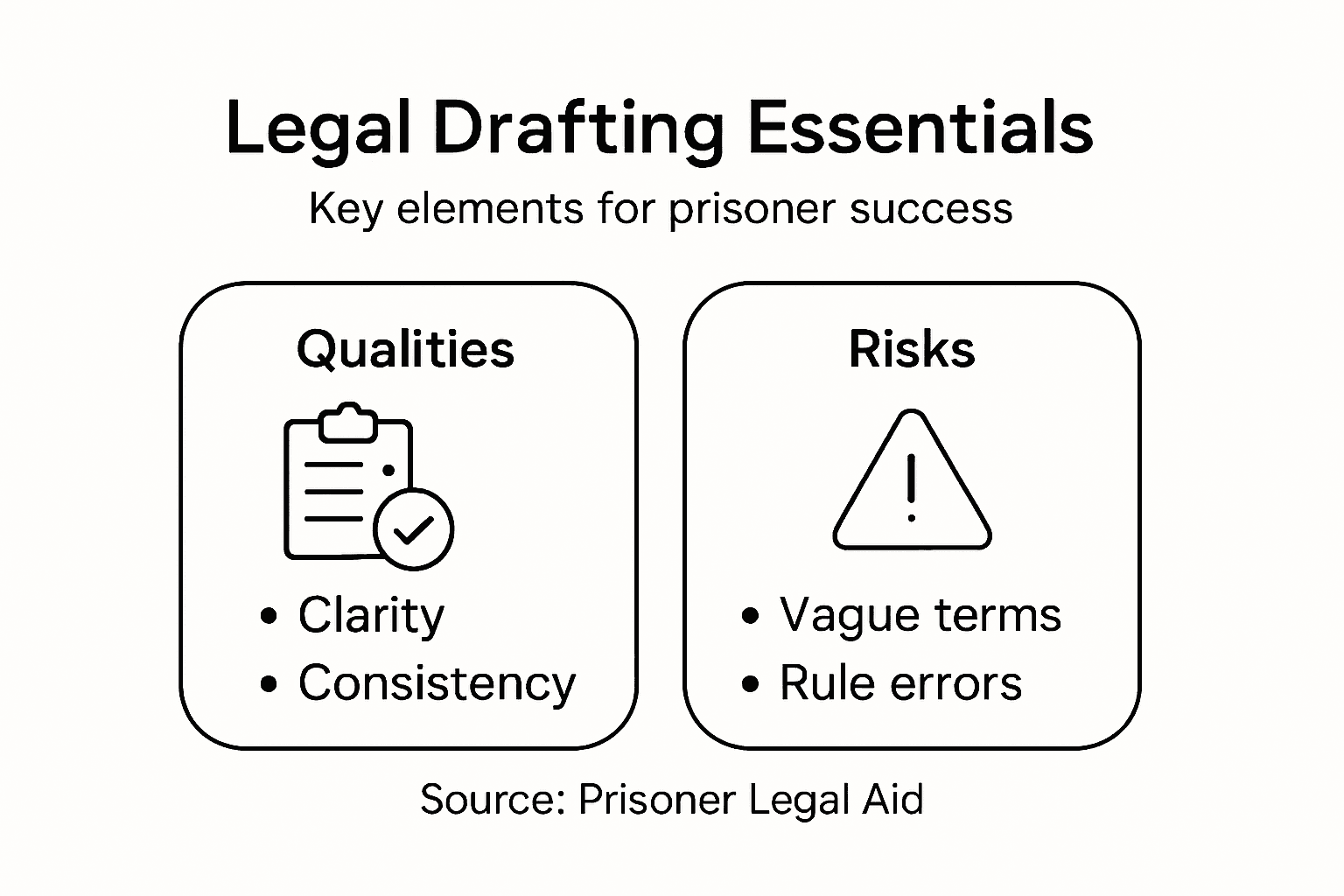
Effective legal drafting rests on four pillars: clarity, precision, consistency, and organization. Without these qualities, your document fails regardless of how strong your underlying legal argument might be. Clarity means a reader can understand your meaning on the first pass without confusion. Precision means you use the exact word that conveys your intended meaning, not an approximation. Effective legal drafting requires clarity, precision, and unambiguity to ensure that only the intended interpretation is possible. When you are filing a habeas corpus petition or a civil rights complaint, you cannot afford ambiguity. The government will interpret your words in ways that hurt your case if given the chance. Your job is to write so clearly that misinterpretation becomes impossible. This is not about using big words or complex sentence structures. It is about using plain English to say exactly what you mean.
Consistency in terminology is critical and often overlooked by pro se litigants. If you refer to the defendant as “Officer Smith” in one paragraph, “the officer” in the next, and “Smith” in a third, you create unnecessary confusion. The reader must constantly ask: Is this the same person? A judge reviewing your motion will become frustrated. Consistency also applies to defined terms. If you define something at the beginning of your brief as “the alleged assault,” use that same phrase throughout your document rather than switching between “the incident,” “the attack,” and “what happened.” This consistency helps a judge follow your argument without mental effort. When you organize your document logically, you reinforce consistency. Each section should build on the previous one. Your facts should lead naturally to your legal claims. Your legal claims should connect directly to the relief you are requesting. This logical flow makes your entire argument stronger. Confusing organization forces judges to work harder to understand you, and judges who must work harder are less likely to rule in your favor.

Another essential quality is understanding your audience and writing with their needs in mind. Your audience is a federal judge who receives hundreds of motions every month. That judge has limited time and attention. You must make your argument easy to grasp. Essential qualities include using consistent terminology and following standardized organization templates to help readers understand their rights and duties clearly. In a prison context, this means explaining what happened in your case in the clearest possible way, then explaining which law was violated and how. Do not assume the judge knows the details of prison operations or the specific statutes you are citing. Explain them. Do not use prison jargon or facility-specific terminology without definition. A judge from outside your facility will not understand facility-specific abbreviations or codes. Define them the first time you use them.
Precision also means choosing the right word for the legal concept you are expressing. There is a difference between “the officer ordered me to” and “the officer suggested that I.” There is a difference between “violated” and “may have violated.” The first is definite. The second is uncertain. In legal writing, you cannot hedge your claims. Either the officer violated your rights or the officer did not. If you are not certain, you should not include it in your legal document. Effective drafting balances detailed obligations with clarity about what you are actually claiming. When you file a section 1983 complaint alleging excessive force, specify exactly what force was used, by whom, when, and what injury resulted. Do not leave it vague. The more specific you are, the stronger your claim appears. Vague allegations get dismissed.
Organization matters because courts expect legal documents to follow conventional structures. A complaint has a caption, numbered paragraphs, counts, and a prayer for relief. An appellate brief has a cover page, table of contents, statement of facts, legal argument organized by issue, and conclusion. Briefs include page breaks, proper spacing, and required fonts. These conventions exist because they make documents easier to read and process. Following them tells the court you understand the system and respect its rules. Violating them suggests you do not understand or do not care. When you file a document that violates these conventions, you signal incompetence before the judge reads a single word of your argument.
Pro tip: After you finish drafting your document, read it aloud at normal speaking pace and mark any place where you stumble or feel confused; rewrite those sentences immediately, because if you stumble reading your own words, a judge certainly will.
Legal Requirements and Procedural Compliance
Procedural compliance is not optional. It is the foundation that determines whether your legal document survives initial review. Courts operate under strict procedural rules that vary by jurisdiction and by court level. A motion filed in federal district court follows different rules than a motion filed in a circuit court. A petition in a state trial court follows different rules than a petition in a federal district court. Your job is to know which rules apply to your case, then follow them precisely. Legal drafting must comply with numerous formal requirements and procedural rules to be valid and enforceable. Compliance ensures that your documents are legally effective and withstand judicial scrutiny. Non-compliance means rejection, regardless of the merits of your case.
Start by understanding the specific procedural rules for your court. The Federal Rules of Appellate Procedure govern filings in circuit courts. The Federal Rules of Civil Procedure govern filings in federal district courts. Most federal courts also maintain local rules that add additional requirements beyond the federal rules. These local rules specify page limits, filing deadlines, required fonts, margin sizes, and how to caption documents. You can find these local rules on your court’s website. Many courts post them as downloadable PDF files. If you cannot access them online, you can request copies by contacting the clerk’s office. Do not guess about procedural requirements. The cost of guessing is the dismissal of your case. Some courts reject documents that violate procedural rules before they are even assigned to a judge for review. The document goes into a pile marked “deficient” and is returned to you with a notice telling you to fix it and resubmit. This delays your case by weeks or months. During that time, deadlines may pass. Statutes of limitations may expire. Your opportunity to pursue your claim may vanish.
Key procedural requirements include proper caption formatting, correct page numbering, appropriate font size and style, and mandatory cover pages for certain documents. A caption identifies the case. It includes the names of all parties, the case number, the court, and the judge assigned to your case. Every page of your document must include a caption. Page numbering must be correct. Margins must meet the specified measurements. Many courts require that briefs use a specific font like Times New Roman or Courier New in a size no smaller than 10 or 12 point. Some courts require specific line spacing. If your brief is too long, courts will reject it. Federal appellate courts limit briefs to 30 pages. Some district courts limit motions to 10 or 15 pages. Exceed the limit and your motion is rejected. Understanding procedural requirements such as bill presentation, amendments, proper formatting, and timing is essential to produce legally valid and operational documents. In a prison context, this means knowing whether your habeas corpus petition must include a certificate of appealability, whether your civil rights complaint must allege specific elements of each claim, and whether your motion must include a memorandum of points and authorities.
Another critical requirement is proper service and filing. You cannot simply mail your document to the court. You must follow specific procedures for filing. Some courts require electronic filing through an online system. Others accept paper filings. Some require both. Filing deadlines are absolute. A motion filed one day late is rejected. A response filed one day late is rejected. Your case clock does not stop because you missed a deadline. The consequences fall on you. Similarly, service requirements mandate that you provide copies of your documents to opposing counsel and sometimes to multiple government agencies. Failure to serve properly means the other party can move to strike your filing or claim they were not given notice of your arguments. When filing a section 1983 civil rights complaint, you must properly serve the defendants. When filing a habeas corpus petition in federal court, you must properly serve the Attorney General and the prison warden. Mistakes in service can be fatal.
Compliance also means using defined terms consistently and using prescribed language where required. Some documents require specific language. A complaint under section 1983 must allege that the defendant acted under color of state law. A habeas corpus petition must establish federal question jurisdiction. An appellate brief must include a statement of the issue being appealed. These requirements are not suggestions. They are mandatory. If your document is missing required elements, it will be rejected or dismissed. Courts have dismissed thousands of pro se filings because they failed to comply with basic procedural requirements. The tragedy is that many of these cases had merit. The litigants simply did not understand or follow the rules. You cannot afford that mistake.
Pro tip: Create a checklist for your specific court that includes every procedural requirement, then review your document against that checklist before filing; cross off each requirement as you verify compliance, because one missed requirement can destroy your entire case.
Risks, Common Errors, and How to Avoid Them
The risks of poor legal drafting are severe and immediate. A single careless word choice can destroy your case. Ambiguous language creates opportunities for courts to interpret your filing in ways that hurt you. Common errors in legal drafting include ambiguity from careless word choice, inconsistent terminology, and failure to consider how language will be interpreted in courts. Such mistakes lead to dismissals, denials of relief, and costly delays. Incarcerated litigants cannot afford delays. Every day you sit in prison waiting for your case to resolve is a day you lose. Every dismissal means starting over. Every rejection means rewriting and refiling. The stakes are real. Your freedom depends on getting this right.
One of the most common errors is using vague language. When filing a civil rights complaint alleging excessive force, do not write: “The officer used excessive force against me.” This is conclusory. It does not state facts. Instead, write: “On March 15, 2023, Officer Johnson struck my head with a baton five times without provocation, causing a laceration that required twelve stitches.” The second version states facts. The first states only a legal conclusion. Courts reject complaints that rest on conclusions rather than facts. Another frequent error is inconsistent terminology. If you refer to an incident as “the assault” in paragraph two, then “the altercation” in paragraph five, then “what happened” in paragraph ten, you create confusion about whether you are describing the same event. Each reference forces the judge to ask: Is this the same incident? Inconsistency undermines your credibility. A third error is failing to connect facts to legal standards. You state what happened, but you do not explain which law was violated or how. A judge will read your factual narrative and then ask: So what? Which law does this violate? If you do not answer that question clearly, your complaint fails. Risks in legal drafting include vague language, failure to cover all contingencies, and ignoring jurisdictional nuances. You must anticipate how your document will be read and interpreted. A judge reading your habeas corpus petition will ask: Does this petition establish federal question jurisdiction? Does it allege facts supporting habeas relief? If the answer is no, your petition is dismissed.
Another critical error is misusing legal terms or borrowing language from case law without adapting it to your specific facts. You read a case that seems to match your situation, so you copy language from that case into your brief. But the case involved different facts or different defendants. The copied language does not fit your circumstances. Courts recognize this immediately. It signals that you do not understand the law you are citing. Similarly, many pro se litigants include language they do not understand because it sounds legal. They write sentences like: “The defendant’s conduct constitutes a prima facie violation of the plaintiff’s substantive due process rights under the Fourteenth Amendment.” But they cannot explain what any of those words mean. If a judge asks you to explain your own filing, you must be able to do so clearly. Misusing legal terms makes you look foolish. It also creates ambiguity about what you are actually claiming.
A fourth error is overlooking procedural requirements and jurisdictional rules. You write a beautiful brief, but you exceed the page limit by three pages. Your brief is rejected. You file a motion in the wrong court or miss a filing deadline by one day. Your motion is rejected. You fail to include required elements in your complaint, like alleging that a defendant acted under color of state law in a section 1983 case. Your complaint is dismissed. These are not subtle errors. They are fatal. To avoid them, you must know the rules for your specific court before you start drafting. You must create a checklist of all procedural requirements, then verify that your document meets each requirement before filing. You must calculate deadlines carefully and file days early, not days late. You must proofread your final document three times.
The solution to these errors is rigorous attention to detail and multiple reviews. Write your document. Let it sit for at least one day. Read it again with fresh eyes. Mark any place that confuses you. Rewrite those sections. Read your document aloud. Listen for sentences that stumble. Rewrite those too. Then have someone else read it if possible. Someone who knows nothing about your case should be able to understand your argument from your document alone. If they cannot, rewrite it again. Use plain English. Avoid legal jargon whenever possible. When you must use legal terms, define them. Verify that your terminology is consistent throughout. Check that every fact is followed by connection to a legal standard. Ensure that your document complies with all procedural requirements. Only after this rigorous review should you file.
The table below summarizes recurring errors in legal drafting and how to avoid them:
| Common Error | Impact on Case | Simple Solution |
|---|---|---|
| Vague language | Case dismissed for lack of detail | Write specific facts, avoid conclusions |
| Inconsistent terminology | Creates confusion, weakens credibility | Use same terms for each subject |
| Missed procedural rule | Document rejected or delayed | Use court rule checklist pre-filing |
| Misused legal terms | Argument is unclear or ignored | Only use terms you fully understand |
Pro tip: Wait at least 24 hours after completing your first draft before reviewing it, because you will catch errors with fresh eyes that you missed when writing, and you will spot vague language more easily after stepping away from your work.
Master Legal Drafting With Expert Help to Protect Your Rights
Legal drafting requires unmatched precision and strict adherence to procedural rules to avoid dismissals and delays. If you feel overwhelmed by the complexity of preparing pleadings, motions, or appeals in federal or state courts, you are not alone. The challenges of using clear language, maintaining consistency, and following court-specific formatting can make or break your case. Many incarcerated individuals struggle to translate their strong legal arguments into documents that judges will accept.
Prisoner Legal Aid understands these obstacles and offers professional legal document preparation services designed to fit the unique needs of incarcerated and self-represented litigants. Whether you need help drafting a habeas corpus petition, a civil rights claim, or an appellate brief, our platform ensures that your documents meet all procedural and formatting requirements. Let us help you avoid common drafting errors such as vague language and missed filing rules so your legal voice reaches the court without delay.
Explore our services today to get started.

Take control of your legal journey by accessing expert assistance that respects confidentiality, guarantees affordability, and delivers quick turnaround times. Visit Prisoner Legal Aid now and ensure your legal documents are precisely crafted to work in your favor.
Frequently Asked Questions
What is legal drafting and why is it important for prisoners?
Legal drafting is the precise craft of writing legal documents that are enforceable in court. For prisoners, accurate legal drafting is crucial because any ambiguity or error can lead to the dismissal of their case before a judge even reviews the merits of their arguments.
How can I ensure clarity in my legal documents?
To ensure clarity, use simple and direct language. Avoid complicated vocabulary and ambiguous terms. Read each sentence aloud to confirm it conveys exactly what you mean without confusion.
What are the common types of legal documents I will need to file as a prisoner?
As a prisoner, you will commonly file pleadings (such as complaints and petitions), motions (requests for specific court orders), and briefs (legal arguments presented to the court). Each type has specific format and content requirements.
What are the risks of poor legal drafting in my filings?
Poor legal drafting can result in the dismissal of your case, delays, and missed opportunities to present your claims. Errors such as vague language, inconsistent terminology, and failure to comply with procedural rules can jeopardize your case significantly.