
Filing a document in United States federal court is not as simple as sending a letter or sliding a paper under a door. For incarcerated individuals or those representing themselves, understanding each step and the meaning behind a proper court filing can decide whether a case is heard or ignored. The process follows the Federal Rules of Civil Procedure, demanding strict procedures, service to all parties, and meeting formatting standards. Knowing what counts as an official submission protects your right to be heard and moves your case forward.
Table of Contents
- Defining Federal Court Filing Basics
- Types of Documents Filed in Federal Court
- Federal Filing Rules and Procedures
- Essential Requirements for Court Submission
- Mistakes to Avoid When Filing Federally
Key Takeaways
| Point | Details |
|---|---|
| Understanding Filing Requirements | Every document must adhere to strict formatting and procedural rules; otherwise, it may be rejected. |
| Deadlines Are Critical | Missing a deadline can lead to permanent dismissal of your case, regardless of circumstances. |
| Proper Service Is Essential | All parties must be served with filed documents to ensure proper legal notice and compliance with court rules. |
| Document Types Matter | Each document type has specific rules regarding formatting, filing, and timing that must be followed to maintain case integrity. |
Defining Federal Court Filing Basics
Federal court filing is the process of submitting legal documents to a United States federal court in compliance with specific procedural rules and formatting requirements. When you file a document in federal court, you are officially entering it into the court’s record and notifying all parties involved in your case. This is fundamentally different from simply writing a letter or keeping documents in a folder at your cell. The moment your filing is accepted by the court, it becomes part of the official case record, and the clock starts running on various procedural deadlines that follow.
Every document you file in federal court must meet strict technical and procedural standards. The Federal Rules of Civil Procedure govern how documents must be formatted, served, and submitted. Proper filing requires serving all parties with copies of documents like pleadings, motions, and notices, unless specific exceptions apply. This means you cannot simply submit something to the court and hope the other side learns about it eventually. Rule 5 ensures that everyone gets notice at the same time, which prevents games where one party tries to surprise another. Your document must include page numbers, proper margins, legible font, and accurate headings. Missing any of these elements can result in your filing being rejected or ignored by the court.
Most federal courts now use Case Management/Electronic Case Files (CM/ECF), which is the federal judiciary’s electronic filing system for documents like pleadings, motions, and petitions. CM/ECF requires you to register with the specific court where you are filing and obtain authorization before you can submit anything electronically. Some federal courts permit pro se litigants (people representing themselves) to file electronically, while others still require paper filings or have limited electronic access for incarcerated individuals. You need to check with your specific court to determine whether electronic filing is available to you and what the requirements are. If you cannot file electronically, you will file by mail, and you must ensure your documents arrive by the deadline, not that you mail them by the deadline. This distinction matters enormously. A document mailed on the due date but received three days later is late, and your case could be dismissed.
Understanding these basics protects your legal rights. Filing deadlines in federal court are not suggestions. Missing a deadline by one day can result in losing your case permanently, without the judge ever reviewing the merits of your claim. Formatting errors can cause your document to be rejected before it is even reviewed. These are not technicalities that sympathetic judges overlook. Federal judges apply the rules as written, and they apply them consistently to all litigants, including those without lawyers.
Pro tip: Before filing anything, contact your specific federal court’s clerk office to confirm current filing procedures, acceptable formats, and whether pro se electronic filing is permitted, since these requirements vary significantly between courts and change periodically.
Types of Documents Filed in Federal Court
Federal court documents fall into several distinct categories, and knowing which type you need is critical to your case strategy. Unlike state courts or administrative agencies, federal courts have standardized document types that serve specific legal functions. The main categories include pleadings (complaints, answers, replies), motions (requests for the judge to take action), discovery materials (requests for information from the other side), and various notices and orders. Each type has different rules about how it must be formatted, when it must be filed, and who must receive copies. Filing the wrong document type or using an improper format can delay your case or result in dismissal.
Pleadings are the core documents that start and shape your case. A complaint initiates a civil lawsuit and outlines your legal claims against the defendant. An answer is the defendant’s response to your complaint, where they admit or deny each allegation. Once the initial complaint and answer are filed, subsequent pleadings like replies address new arguments raised in the answer. Then come motions, which are written requests asking the court to make a decision or take an action before trial. Common motions include requests to dismiss the case, extend deadlines, or compel the other side to provide information. Discovery materials include interrogatories (written questions), requests for production of documents, depositions, and requests for admissions. These documents help both sides gather facts and evidence before trial. Finally, notices and orders serve various functions in the litigation process, including notices of motion, notices of appearance, offers of judgment, and court orders.
The United States Courts system provides national federal court forms for civil, criminal, bankruptcy, and other case types to help litigants use consistent formats. These forms include templates for complaints, summons, subpoenas, notices, judgments, and waivers. Many federal courts also maintain their own local forms that comply with specific court requirements. Using the correct form matters because judges and court staff process thousands of documents monthly, and documents that deviate from standard formats often get rejected or delayed. Your federal court’s website will have a forms page where you can access the official forms for your specific district. Some courts provide detailed instructions with their forms, explaining what information goes in each blank and what supporting documents you must attach.
Beyond these standard document types, your case might require specialized filings depending on your legal claims. For example, if you are filing a habeas corpus petition under 28 U.S.C. Section 2254, you need a petition form specific to that statute. Civil rights claims under 42 U.S.C. Section 1983 require a complaint following civil procedure rules. If you are seeking sentence reduction, you might file a motion under 28 U.S.C. Section 2255 for federal prisoners or state equivalents. Each specialized claim type has its own procedural requirements and deadline rules. The deadline for filing can be weeks, months, or even years depending on the claim type, and you lose the right to file if you miss the deadline. This is why understanding document types goes beyond knowing what to call something; it directly affects your ability to protect your legal rights.
Here is a summary of common federal court document types and their main purposes:
| Document Type | Main Purpose | Typical Timing |
|---|---|---|
| Complaint | Starts a civil lawsuit | Case initiation |
| Answer | Responds to allegations in complaint | 21 days after service |
| Motion | Requests judge to act before trial | Variable, often pre-trial |
| Discovery Request | Seeks facts and evidence from other side | As scheduled by court |
| Notice | Provides official information to parties | When needed in case |
| Order | Court’s directive affecting case actions | Issued by judge |
Pro tip: Download all forms and local rules from your specific federal court’s website before drafting any document, and confirm filing deadlines in writing with the court clerk, since procedural deadlines vary by case type and court district.
Federal Filing Rules and Procedures
The Federal Rules of Civil Procedure (FRCP) form the backbone of all civil litigation in federal district courts. These rules are not optional guidelines or suggestions. They are mandatory requirements that govern everything from how you start a lawsuit to how you serve documents on the other party to how you respond to the court’s orders. Violating these rules can result in sanctions, case dismissal, or loss of your claims entirely. The FRCP covers commencement of actions, summons issuance, pleadings and motions, discovery, trials, judgments, and appeals. What makes these rules particularly important for self-represented litigants is that judges apply them uniformly to everyone, regardless of whether you have an attorney. The rules are designed to ensure just, speedy, and inexpensive resolution of cases, meaning the court system prioritizes moving cases forward efficiently while protecting everyone’s right to be heard.
The Federal Rules of Civil Procedure establish strict formatting and filing requirements that you must follow exactly. Your documents must be typed on paper that is eight and one-half by eleven inches (standard letter size), with one-inch margins on all sides, using at least 12-point font in a legible style. Page numbers must appear at the bottom of each page. Each document needs a caption that identifies the court, the case name, the case number, and the document title. Pleadings must be double-spaced, though some documents like certificates of service can be single-spaced. These specifications exist for practical reasons: they make documents easier to read, photocopy, scan into the court’s electronic system, and file in physical form if necessary. A document that does not meet these specifications can be rejected by the court clerk before a judge even sees it. You cannot appeal this rejection by arguing that your argument was good even if the formatting was wrong. The format is the threshold requirement.
Filing deadlines are perhaps the most critical procedural requirement you will encounter. In federal court, most responsive pleadings (like an answer to a complaint) must be filed within 21 days of service, though this deadline can be extended by agreement between parties or by court order. Motions often have 14-day response deadlines. Motions seeking extensions must typically be filed before the original deadline passes. If you file something one day late without proper permission, your filing is untimely, and the court will likely reject it or strike it from the record. There is no judicial discretion here for good-faith mistakes or reasonable misunderstandings. The deadline is the deadline. For incarcerated litigants, there is one exception called the prison mailbox rule. If you submit your document to prison staff for mailing by the deadline, your filing is considered timely even if it arrives at the courthouse several days later. However, you must establish that you actually placed the document in the prison mail system on time, which means you need to keep detailed records showing the date and time you handed it to staff.
Key Procedural Timing Requirements
- Summons and service: You must serve the defendant within 90 days of filing the complaint, or the court may dismiss your case
- Answers to complaints: 21 days from service of the complaint
- Responses to motions: 14 days after the motion is served
- Discovery requests: Must be served by a specified deadline set by the court
- Trial or resolution: Most cases have a scheduling conference within 90 days of filing where the judge sets all future deadlines
Service of documents on other parties is as important as filing with the court. You cannot simply file something with the court and ignore the other side. Procedural rules require that you serve all other parties with copies of every document you file, except for certain ex parte motions (requests made without the other side present). Service methods include personal delivery, email (if the party consents), first-class mail, or court-ordered alternatives. You must keep proof of service, usually in the form of an affidavit or certificate of service attached to your filing, showing that you actually served the other parties. If you claim to have served someone by mail but cannot prove it, the court may refuse to consider your filing. The practical consequence is that you need organized systems for tracking when you served documents and how you served them.
Amendments to the Federal Rules of Civil Procedure happen periodically, with updates designed to improve clarity and efficiency. The 2024 rules continue to evolve based on judicial experience and feedback from practitioners. This means that the rules you need to follow today may differ slightly from what someone learned years ago. Before you begin drafting any document, check whether the rule you are relying on has been amended recently. Court websites usually post rule changes prominently. Local federal courts also create supplemental local rules that add requirements on top of the federal rules. For example, your specific court might require that motions be submitted with a cover page, that exhibits be labeled in a particular way, or that certain documents be filed under seal. Violating local rules is just as problematic as violating federal rules.
Pro tip: Obtain a current copy of the Federal Rules of Civil Procedure and your specific court’s local rules from the court’s website, print them out, and keep them accessible while you draft documents, checking the rule section relevant to each document type before filing.
Essential Requirements for Court Submission
Every document you submit to federal court must meet a precise set of requirements before the court will even consider it. These are not recommendations or best practices. They are mandatory criteria that determine whether your filing is accepted or rejected. A technically flawless legal argument becomes worthless if your document fails to meet these requirements because the court clerk will simply refuse to file it. The submission requirements cover three main areas: proper formatting and signature, timely service on all parties, and compliance with electronic or physical filing protocols. Understanding these requirements is the difference between your case moving forward and your claims being dismissed before a judge ever reads them.
Essential service requirements mandate that you serve copies of every document on all parties to the lawsuit, except in specific circumstances where the court permits otherwise. This means if there are three defendants in your case, you must serve all three defendants with copies of every motion, response, and document you file with the court. The acceptable methods of service include personal delivery in hand, certified mail to a known address, leaving a copy at their office or residence, electronic service with consent, or court-approved alternatives. You cannot simply mail something and hope it arrives. You must use a method that can be proven. Every filing must include a certificate of service or affidavit of service as proof that you served the other parties. This certificate goes at the end of your document and states the names of parties served, the method of service, and the date of service. Without it, your filing may be rejected or disregarded by the court.
Formatting requirements are strict and non-negotiable. Your documents must be submitted on standard eight and one-half by eleven inch white paper with one-inch margins on all sides. Text must be printed in a legible font, at minimum 12 points in size, using single or double spacing as appropriate for the document type. The first page must include a caption that shows the court name, case number, names of parties, and the document title. Page numbers must appear at the bottom of each page. All pleadings and motions must be signed by you or your attorney. If you are acting as a pro se litigant, your signature certifies that you have read the document, believe it is factually accurate, and that it is not frivolous or intended to harass anyone. False signatures or certifications can result in sanctions by the court. The signature must be an actual signature in ink if filing by paper, or an electronic signature if filing through the court’s system. Initials or printed names do not satisfy the signature requirement.
Critical Submission Checklist Before Filing
- Document uses proper caption with court, case name, and case number
- Text is legible, 12-point minimum font, proper margins (1 inch all sides)
- All pages are numbered at the bottom
- Document is signed by you (pro se) or attorney
- Certificate of service is attached showing parties served, method, and date
- Filing deadline has not been missed
- Local court rules have been checked for additional requirements
- If filing electronically, correct document type has been selected
- If filing by mail, envelope is addressed to correct court address
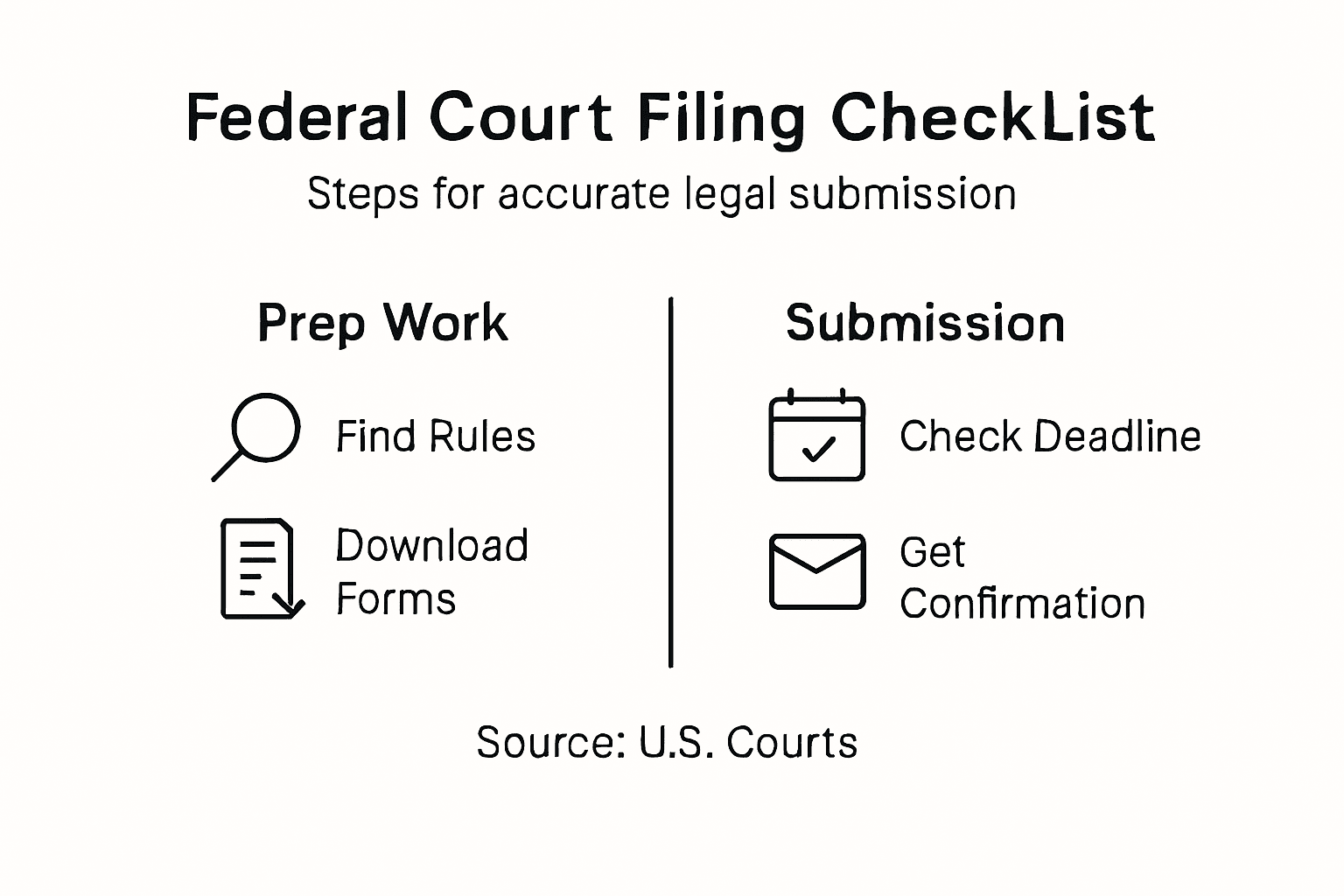
Electronic filing through the CM/ECF system requires additional compliance measures. You must have a registered PACER account and court-specific authorization before you can file. Some federal courts permit pro se litigants to file electronically, while others restrict electronic access to attorneys only. If your court permits pro se electronic filing, you will need to create login credentials and follow the court’s specific procedures for uploading documents. Electronic filings must comply with the same formatting rules as paper filings, but you also must ensure that your document is in an acceptable file format (usually PDF) and does not exceed the court’s size limits. The system will often reject filings that do not meet technical specifications. If you upload a document with sensitive information like Social Security numbers, bank account numbers, or personal identifying information, you must redact that information before filing, as the electronic case file is publicly accessible. The court provides specific formatting for redaction, usually black boxes covering the sensitive information. Filing electronically creates an automatic receipt that proves you filed on time, which is a major advantage over mailing documents.
When filing by mail, the timing rules are different from electronic filing. Your document must be placed in the prison mail system or regular postal mail by the filing deadline to be considered timely. If you are incarcerated, the prison mailbox rule means your document’s filing date is the date you placed it in the prison mail system, not the date it arrives at the courthouse. You must keep proof of this. For non-incarcerated filers, mailing a document by the deadline does not make it timely if it arrives late. You should mail documents well in advance of deadlines to account for postal delays. Use tracked mail services when possible so you can prove delivery. Address your envelope to the correct address for your specific court district, as each federal court has its own office address. Filing the document at the wrong address can result in delays or failure to file.
The following table compares electronic and paper filing in federal court:
| Filing Method | Access Requirement | Receipt Confirmation | Common Pitfalls |
|---|---|---|---|
| Electronic (CM/ECF) | PACER account & court approval | Instant electronic receipt | Wrong file format, size limits |
| Paper (Mailing) | No online account needed | Postal delivery receipt | Delayed arrival, wrong address |
| In-person | Clerk office visit required | Stamped court copy | Travel limits, office hours |
Pro tip: Create a pre-filing checklist based on your court’s local rules and the Federal Rules of Civil Procedure, check every box before submitting anything, keep copies of everything you file with proof of service dates, and maintain a filing calendar marking all deadlines to prevent missed submissions.
Mistakes to Avoid When Filing Federally
Pro se litigants make filing mistakes that cost them cases every single day. Most of these mistakes are entirely preventable. The difference between a successful filing and a dismissed case often comes down to whether you took the time to verify details before submission. Federal judges do not give credit for effort or good intentions. They enforce the rules as written. If you miss a deadline by one day, your case gets dismissed, period. If you fail to serve the other party, your filing may be ignored. If you include private information like your Social Security number or bank account number in a document filed electronically, that information becomes public record forever. These are not small oversights. They are case-ending mistakes that you can prevent with attention and planning.
The most common and devastating mistake is missing filing deadlines. This happens more often than you might think, especially for incarcerated filers who do not have control over mail timing. You write your response to a motion, you hand it to prison staff to mail, and you assume you are done. Then the prison mail system takes five days to deliver it, it arrives at the courthouse late, and your filing is rejected. The court does not care that you completed the work on time. What matters is when the courthouse receives it. The prison mailbox rule provides some protection for incarcerated filers, but only if you actually placed the document in the mail system before the deadline and can prove it. Another common deadline mistake happens when you miscalculate the number of days you have to respond. A 21-day deadline means 21 calendar days, not 21 business days. If the deadline falls on a weekend, you must file by the end of business on Friday. If the deadline falls on a federal holiday, you get one extra day. You must check your jurisdiction’s rules on holiday extensions, as they vary. Missing deadlines also happens when filers do not track multiple deadlines in the same case. You have a deadline to answer a complaint, another deadline to respond to discovery requests, and another deadline to file a motion. Keeping organized is not optional. You need a written calendar or system that alerts you to every deadline in your case.
Pro se litigants frequently make mistakes related to document preparation and service that cause case dismissals. Failing to serve copies of documents on the opposing party ranks high on this list. You cannot file something with the court and ignore the other side. Every document must be served on every other party in the case unless the court specifically excuses service. Your certificate of service must list exactly who you served, what method you used, and the date you served them. If you claim to have served someone by mail but you actually gave it to a cellmate to deliver, and that cellmate lost it, your certificate is false. False certifications can result in sanctions against you. Another common mistake is improper formatting. Documents with margins that are too narrow, fonts smaller than 12 points, or missing page numbers get rejected by court clerks. You cannot argue that your legal reasoning was sound despite the formatting errors. The formatting is the threshold requirement. Missing signatures is another error that seems simple but happens repeatedly. Your document must be signed in ink if you are filing by paper. A printed name does not count. Initials do not count. Your actual signature is required. For electronic filings, you may use an electronic signature, but you must follow the specific format your court requires. Many filers also include private information that should have been redacted. Social Security numbers, bank account numbers, dates of birth, and personal identifying information should not appear in documents filed in federal court, especially if they are filed electronically where they become public. If you include this information, you must black it out before filing.
Common Filing Mistakes and How to Prevent Them
-
Missing filing deadlines: Calculate deadline dates in writing, mark them on a calendar, submit documents early to account for mail delays, use the prison mailbox rule correctly by keeping proof of mail submission dates
-
Failing to serve other parties: Create a list of all parties in your case and their addresses, keep copies of every document served, write a certificate of service for every filing that lists who was served and when, consider using certified mail so you have proof of delivery
-
Improper formatting: Use 12-point minimum font, 1-inch margins on all sides, legible font styles, page numbers at the bottom of each page, proper caption with court name and case number
-
Missing or improper signatures: Sign documents in ink (not printed names or initials) for paper filings, follow your court’s electronic signature requirements for e-filings, ensure every signature is dated
-
Including sensitive information: Redact Social Security numbers, bank account numbers, dates of birth, and other personal identifiers, use black boxes for redaction if required by your court, verify that electronic filings do not expose sensitive information before submission
-
Failing to check local court rules: Different federal courts have different local rules that impose additional requirements beyond the Federal Rules of Civil Procedure, your court’s website contains these local rules, check them before drafting every document
Electronic filing errors represent a growing category of mistakes. Common e-filing mistakes include failing to confirm that you have proper electronic access credentials before attempting to file, uploading documents in the wrong file format (the court specifies PDF or other formats), exceeding file size limits that the system imposes, selecting the wrong document type from the court’s menu, and neglecting to verify that the system confirmed your filing was received. Electronic filing systems sometimes accept a filing but then later reject it for technical reasons. You do not know this happened unless you check the docket daily. Some courts send email notifications of rejections, but others do not. You must take responsibility for monitoring your filings. If a document is rejected, you need to know immediately so you can resubmit before the deadline expires. Another electronic filing mistake involves electronic service. If your court permits electronic service, serving documents via email, the rules require that you have consent to serve that party electronically. Serving someone electronically without consent is improper service, and your filing may be disregarded.
Pro tip: Create a master filing checklist specific to your federal court district, review it before submitting any document, maintain a detailed deadline calendar updated weekly, keep copies of every filing and proof of service in a secure location, and contact the court clerk by phone or email at least five days before each deadline to confirm the deadline and filing procedures.
Secure Your Federal Court Filings with Confidence and Accuracy
Navigating federal court filing procedures demands precision, strict adherence to formatting rules, and perfectly timed submissions. Missing a deadline or making a formatting error can result in dismissal or rejection before a judge ever reviews your case. If you are representing yourself or are incarcerated, these challenges multiply. Prisoner Legal Aid understands how overwhelming it can be to prepare complex legal documents like habeas corpus petitions and civil rights claims while ensuring full procedural compliance. Our service helps you avoid common pitfalls such as missed deadlines, improper service, and incorrect document formatting, so your filings get accepted and your rights stay protected.

Ready to eliminate the stress of federal filings and maximize your chances of success? Visit Prisoner Legal Aid for professional legal document preparation tailored specifically for self-represented and incarcerated individuals across the United States. Learn how our affordable and confidential services can support your case by drafting, formatting, and preparing your documents to meet all federal rules and local requirements. Don’t risk dismissal due to a simple technical error — get expert help today and focus on your legal strategy with confidence. Start by exploring our services and take control of your federal court filing now.
Frequently Asked Questions
What is federal court filing?
Federal court filing is the process of submitting legal documents to a United States federal court, following specific procedural and formatting rules. This process officially enters documents into the court’s record and notifies all parties involved in a case.
Why is accuracy important in federal court filing?
Accuracy is crucial because errors in formatting, missed deadlines, or improper service of documents can lead to rejections by the court, sanctions, or even dismissal of your case, regardless of the merits of your claims.
What are common mistakes to avoid when filing in federal court?
Common mistakes include missing filing deadlines, failing to serve documents on all parties, using improper formatting, missing signatures, including sensitive information, and neglecting to check local court rules.
How can I ensure my federal court filing is compliant with the rules?
To ensure compliance, use the correct formatting, file within the deadlines, serve all documents properly, keep records of service, and check both the Federal Rules of Civil Procedure and your specific court’s local rules before submitting any documents.