
Every day, people in prisons across the United States face challenges that threaten their rights and dignity. The Basic Principles for the Treatment of Prisoners, adopted by the United Nations, affirm your right to legal aid and remind you that incarceration does not erase your fundamental freedoms. For individuals seeking justice through habeas corpus petitions or civil rights claims, access to equal protection under law depends on having well-prepared legal documents. Reliable legal aid bridges the gap between knowing your rights and fighting for them effectively.
Table of Contents
- Legal Aid In Prison: Core Principles
- Types Of Legal Help Available To Inmates
- How Document Preparation Services Support Prison Cases
- Legal Rights, Eligibility, And Court Procedures
- Risks Of Self-Representation Versus Legal Aid
- Costs, Mistakes, And Confidentiality Concerns
Key Takeaways
| Point | Details |
|---|---|
| Legal Rights Retained | Incarceration does not eliminate your constitutional rights, including the right to legal representation and to challenge unlawful conditions. |
| Access to Legal Aid | Quality legal assistance is essential for navigating the complex court system and preventing procedural mistakes. |
| Self-Representation Risks | Representing yourself can significantly reduce your chances of success due to procedural errors and lack of legal knowledge. |
| Importance of Documentation | Properly formatted legal documents are crucial, as errors can lead to case dismissal without consideration of the merits. |
Legal aid in prison: Core principles
At its core, legal aid in prison rests on a fundamental recognition: incarceration removes your freedom, but it does not erase your legal rights. The treatment of prisoners framework established by international standards makes this clear. Except for necessary limitations directly imposed by incarceration itself, you retain human rights and fundamental freedoms. This means you have the right to legal representation, the right to file grievances, and the right to challenge unlawful conditions or practices affecting you. Legal aid exists specifically to bridge the gap between these rights and your ability to exercise them when you lack financial resources or legal knowledge.
The principle of equal protection under law stands at the heart of legal aid. Without access to quality legal assistance, incarcerated individuals face an impossible choice: navigate complex federal and state court systems alone or go without justice. This creates a two-tiered system where those with money can afford lawyers while those without are left vulnerable to procedural errors, missed deadlines, and lost claims. Legal aid services work to level this playing field by providing professional document preparation, filing assistance, and strategic guidance. When you have access to proper legal support, you can identify valid claims, understand procedural requirements, and present your case in a way courts recognize and respect.
Another core principle is dignity in the legal process itself. The justice system requires specific formatting, precise language, and adherence to procedural rules that seem arbitrary to someone without legal training. A single misplaced comma or missing signature can result in your petition being dismissed. Professional legal aid services ensure proper document preparation so your claims reach the court intact and ready for consideration. This matters because your case deserves to be heard on its merits, not dismissed on technical grounds. When your legal documents are prepared correctly, judges actually evaluate whether your rights were violated, rather than throwing out your case due to procedural defects.
Pro tip: Document and record every significant interaction or incident that affects your rights or safety while incarcerated, including dates, names of staff involved, and witnesses, as this detailed information becomes invaluable when working with legal aid professionals to build a compelling case.
Types of legal help available to inmates
Legal assistance for incarcerated individuals comes in several distinct forms, each designed to address different aspects of your situation. Understanding what’s available helps you determine which resources match your specific needs and circumstances. The landscape includes organizations offering free legal services, self-help resources you can use independently, and professional document preparation assistance for those who can afford modest fees.
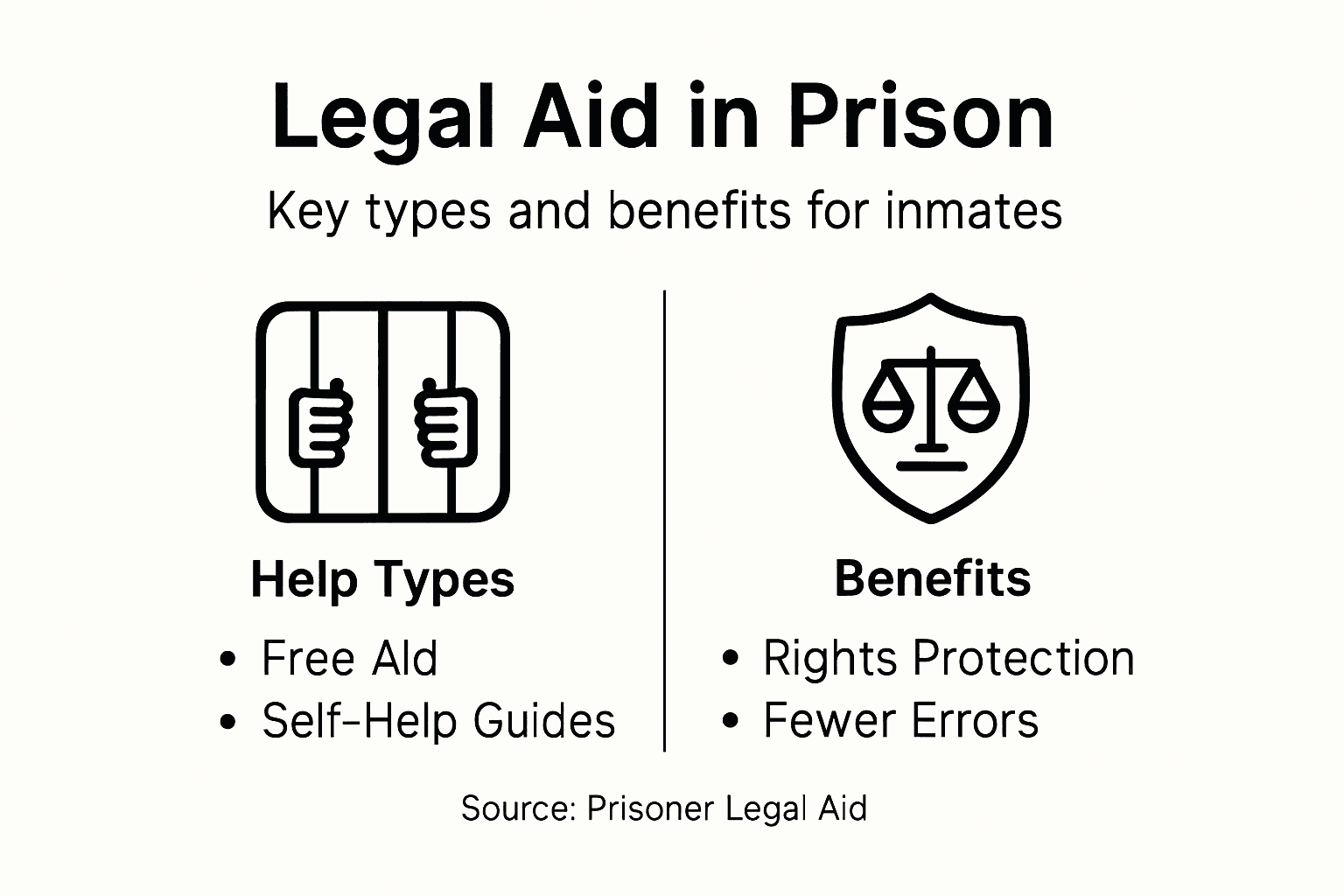
Free legal assistance organizations represent your first line of access. Nonprofits and law firms throughout the country provide completely free legal help to incarcerated people addressing civil matters like challenging unlawful sentences, fighting prison condition violations, and filing civil rights claims. Organizations providing free legal assistance maintain updated directories so you can identify groups serving your state or region. Many specialize in specific areas: some focus exclusively on habeas corpus petitions, others on Section 1983 civil rights claims, and still others on conditions of confinement cases. The catch is that many free organizations operate with limited staff and have waiting lists, meaning your case might take months or even years before they can take it on. However, if they accept your case, you get experienced lawyers working on your behalf at no cost.
Self-help legal guides and resources give you tools to navigate the system yourself or understand your rights more deeply. Comprehensive handbooks for incarcerated individuals provide detailed information about constitutional and statutory rights, explain the legal processes for different types of claims, and include sample pleadings you can study or adapt. These guides cover specific situations: women in prison, transgender individuals, pretrial detainees, and immigration detainees all have tailored resources. The advantage here is immediate access and no cost. You can learn at your own pace and understand the mechanics of filing legal actions. The disadvantage is that self-help requires serious effort and carries the risk that procedural mistakes will derail your case.
Professional legal document preparation services fill the middle ground between free legal aid and hiring a private attorney. These services help you draft, format, and finalize legal documents that meet court requirements without providing legal advice or representation. You maintain control over your case’s direction while getting professional expertise in document preparation, citation formatting, and procedural compliance. This option requires payment but typically costs significantly less than hiring a lawyer.
Pro tip: Start by contacting organizations in your state that specialize in your specific legal issue, as free legal aid services often move faster than general organizations and may have better success rates for particular claim types.
Here’s a comparison of legal help options available to incarcerated individuals:
| Legal Help Type | Cost Range | Advantages | Main Limitations |
|---|---|---|---|
| Free Legal Organizations | No cost | Experienced lawyers, no fees | Long wait times, strict eligibility |
| Self-Help Resources | No cost | Immediate access, learn at your pace | High risk of mistakes, no representation |
| Document Preparation Services | $200–$3,000 | Proper formatting, faster than free aid | Fees required, no legal advice |
How document preparation services support prison cases
Document preparation services operate at the intersection of law and precision. Your case depends entirely on paperwork. A habeas corpus petition, a Section 1983 civil rights claim, or an appeal must be formatted correctly, contain accurate citations, and follow specific procedural rules that vary by court. One missing signature line, one improperly cited case, or one deadline missed by a single day can result in dismissal. Document preparation professionals understand these technical requirements inside and out, which is why their support matters so deeply for prison cases.

The core function is transforming your facts and arguments into legally formatted documents that courts will actually consider. You might have a strong claim about unconstitutional conditions or illegal punishment, but if that claim is buried in disorganized paragraphs with poor citations, judges often dismiss it before even reading the substance. Professional document preparation services help you structure your arguments logically, cite controlling law correctly, and present evidence in the format courts expect. They ensure proper documentation practices meet court standards so your rights receive fair consideration. Beyond formatting, these services help you organize complex timelines, cross-reference incidents, and present your case coherently. If you’re alleging a pattern of abuse, for example, a professional service helps you document each incident with dates, witnesses, and relevant details in a way that builds a compelling narrative rather than appearing as scattered complaints.
Document preparation also protects against procedural traps that catch many self-represented prisoners. Federal and state courts have different filing requirements, different page limits, different font sizes, and different rules about what must appear on cover pages. Missing these details wastes months of your time. Professional services know these rules intimately and apply them consistently. They handle formatting so you can focus on gathering facts and communicating your experience. They also often identify gaps in your documentation or arguments before submission, giving you the opportunity to strengthen your case rather than discovering problems after a court rejection.
Another critical support is ensuring compliance with filing deadlines and procedural sequences. Some claims must be exhausted before others can proceed. Some courts require specific certifications. Some cases need particular formatting for attachments. Document preparation professionals track these requirements and ensure every element aligns with court rules. This reduces the likelihood of dismissal on technical grounds and increases the chances your case receives substantive review on its actual merits.
Pro tip: Gather all your documentation, incident reports, grievance responses, and relevant correspondence before meeting with a document preparation service, as having organized materials significantly speeds up the process and reduces overall costs.
Legal rights, eligibility, and court procedures
Incarceration strips away your freedom, but it does not strip away your constitutional rights. This distinction matters profoundly. You retain protections against cruel and unusual punishment under the Eighth Amendment, access to due process protections, and the right to challenge the legality of your conviction or sentence. You also maintain rights to protection from discrimination and abuse, access to legal assistance, and fair treatment in disciplinary proceedings. Understanding what rights you actually possess is the foundation of any legal action. Many incarcerated individuals believe they have lost all rights simply because they are imprisoned. That is not true. The system is restricted, limited, and heavily stacked in favor of prison officials, but your core constitutional protections remain.
Eligibility for legal aid and court procedures varies depending on your specific situation and the type of claim you want to pursue. Many legal aid organizations prioritize cases involving unconstitutional conditions, abuse, or improper sentencing. However, they have limited resources, so they often cannot accept every eligible case. Eligibility frequently depends on whether you are indigent, meaning you lack sufficient funds to hire a private attorney. Some organizations also consider factors like the strength of your claim, whether you have already pursued administrative remedies, and whether your case raises novel legal issues affecting multiple prisoners. Eligibility for legal assistance and due process rights depend on individual circumstances and the specific organization you contact.
Before filing most court cases, you must exhaust administrative remedies. This means you need to file grievances through your prison’s internal system first, document the responses, and demonstrate that you attempted to resolve the issue internally. This requirement exists in federal law and most state systems. It sounds counterintuitive because prison officials control the grievance process, but courts will typically dismiss your case if you skip this step. The exhaustion requirement slows things down significantly, sometimes adding six months to a year to your timeline. However, it is mandatory. Document everything at each step: file dates, response deadlines, the content of responses, and how long the process took. This documentation becomes critical evidence when you eventually file court claims.
Court procedures themselves have specific requirements depending on whether you are filing in federal or state court, whether your claim involves habeas corpus or civil rights, and which specific court has jurisdiction. Federal courts generally defer to prison officials within constitutional boundaries, meaning you must present clear evidence of constitutional violations. Courts expect proper formatting, accurate legal citations, and organized presentation of facts. Many courts have standing orders requiring specific font sizes, margin widths, page limits, and other technical specifications. Missing these requirements can result in dismissal without review of your actual claims.
Pro tip: Before spending time and money on any legal action, request a copy of your prison’s grievance procedures and your state’s administrative appeal process, as understanding these requirements upfront will help you document everything properly and avoid disqualifying mistakes.
Risks of self-representation versus legal aid
You have the constitutional right to represent yourself in court. That right is real and protected. However, exercising that right comes with serious consequences that most people underestimate. Courts do not lower their standards for self-represented litigants. You still must follow all procedural rules, cite cases correctly, meet all deadlines, and present evidence in admissible form. The difference is that when you make mistakes, nobody corrects you. When you miss a deadline, your case gets dismissed. When you cite a case incorrectly, judges notice. Self-representation carries significant risks especially for individuals unfamiliar with legal procedures and substantive law. Statistics tell a grim story: self-represented litigants lose substantially more cases than those with legal assistance. In some jurisdictions, the difference in success rates approaches 70 percent.
The practical obstacles are immense. Prison law libraries vary wildly in quality. Some facilities have decent legal resources and trained inmate law library workers. Many have outdated books, missing volumes, and no access to current case law. You might spend weeks researching a legal issue only to discover you were reading overruled cases. Federal and state court rules constantly change. A procedure you learned five years ago might be completely different now. Without legal training, you cannot know what you do not know. You might draft a petition that looks complete to you but is missing a required element that causes automatic dismissal. You might file in the wrong court, use the wrong form, or miss a critical deadline because you did not understand how court calendars work. Each of these mistakes costs you months or years, and you cannot undo them through appeals based on your own error.
Beyond procedural problems, self-represented litigants lack substantive legal knowledge needed to identify winning arguments or understand how courts interpret law. You might believe your claim is straightforward, but the law might require you to prove specific elements in a particular sequence, cite specific cases establishing precedent, or distinguish your facts from similar cases where courts ruled against prisoners. Without legal training, you cannot see these complexities. Additionally, judges take less time with self-represented cases because they expect lower quality work. When an attorney files something, judges assume it meets professional standards. When you file something, judges scrutinize it more carefully looking for defects. This creates a paradoxical situation where self-representation actually invites more critical review.
Legal aid services, whether free organizations or professional document preparation services, eliminate most of these risks. They know current law, understand local court procedures, and spot issues you would miss. They format documents correctly so your case survives the initial screening. They understand filing deadlines and procedural sequences so your claims are not dismissed before judges even consider them. Most importantly, legal assistance means your substantive arguments get considered on their merits rather than being lost in procedural confusion.
Pro tip: Even if you cannot afford full legal representation, contact at least three legal aid organizations in your state before deciding to represent yourself, as many have sliding scale fees, emergency assistance programs, or might accept your case despite their waiting lists.
Costs, mistakes, and confidentiality concerns
The financial reality of legal aid matters deeply. Free legal organizations exist, but they operate with limited budgets and cannot accept every case. Professional document preparation services charge fees, typically ranging from a few hundred dollars for simple petitions to several thousand dollars for complex cases involving multiple claims. These costs are substantial when you are incarcerated with minimal income. However, the alternative—making a costly procedural mistake on a pro se petition—often costs far more in wasted time. A single missed deadline or procedural error can result in your case being dismissed entirely, forcing you to start over or forfeit your legal claims completely. From this perspective, paying for professional assistance upfront is an investment in protecting your rights, not an unnecessary expense.
Mistakes in legal documents are remarkably easy to make and remarkably hard to fix. A missing page number in your appendix. A citation formatted slightly wrong. A signature in the wrong location. A deadline miscalculated by one day. Courts dismiss cases for these errors without considering whether your underlying claim has merit. Once dismissed, correcting the error through appeal is difficult and often impossible. You cannot simply resubmit the corrected version—you must follow appellate procedures, which have their own procedural requirements and deadlines. Professional preparation services catch these mistakes before submission, meaning your case reaches the court in complete, correct form. This protection against procedural dismissal justifies the investment for many incarcerated individuals.
This summary highlights common procedural mistakes and their consequences in prison legal filings:
| Common Mistake | Typical Consequence | Prevention Method |
|---|---|---|
| Missed Deadline | Case dismissed, loss of claim | Calendar tracking, deadline checklists |
| Incorrect Formatting | Immediate rejection by court | Use professional services, court templates |
| Incomplete Documentation | Evidence not considered | Organize all records, review before filing |
| Missing Signature | Automatic denial | Double-check signatures on all pages |
Confidentiality represents another critical concern that many people overlook. When you work with legal aid organizations or professional document preparation services, your communications and case information should remain confidential. However, prison mail is monitored and can be intercepted. Proper management of confidential information in prison settings requires strict protocols to protect your privacy while meeting legitimate institutional needs. Some facilities have attorney mail procedures that bypass normal monitoring, but these vary by location. When selecting a legal aid provider, ask specifically about their mail security and confidentiality protections. Reputable organizations understand prison security concerns and work within those constraints while protecting your legal information. Be cautious about discussing your legal case broadly with other inmates, as information shared in common areas or housing units is not confidential and can be used against you later. Guard your legal documents carefully, keep copies secure, and understand that anything you leave accessible can be read by prison staff or other inmates.
Another confidentiality risk involves what happens to your case information after the case concludes. Reputable legal aid providers maintain confidentiality standards and secure case files properly. Less scrupulous services might not. Before engaging any provider, ask about their data security policies, how long they retain files, and what happens if you request document destruction. Ask whether they share information with other agencies or organizations. Ask about breaches and how they respond to data security incidents. These questions might seem excessive, but your legal information is sensitive. It contains details about your case, your background, your location, and potentially sensitive personal information. You want it handled responsibly.
Pro tip: If using a document preparation service, always verify that they accept attorney mail or have secure communication methods, and specifically ask about their confidentiality policies and data security practices before sharing any information about your case.
Secure Your Legal Rights with Professional Document Preparation
Facing complex court procedures and strict filing requirements while incarcerated can be overwhelming. The article highlights how minor errors in legal documents or missed deadlines can dismiss your case before it is even heard. You need precise, court-ready paperwork that respects the detailed procedural rules for habeas corpus petitions and civil rights claims. Your rights deserve to be defended on substance, not lost to technical mistakes or confusion over filing protocols.
Prisoner Legal Aid specializes in helping self-represented individuals in prison draft and format legal documents that meet federal and state court standards. We understand the critical importance of proper legal document preparation to protect your constitutional rights and ensure your case receives the fair review it merits. Our service prioritizes confidentiality, affordability, and fast turnaround times — essential for prisoners working under restrictive conditions.
Discover how our document preparation services can eliminate procedural risks and increase your chances of success.
Explore our detailed service descriptions to learn how we can assist you with your specific legal filings.
Need expert guidance on your next legal step? Contact us to start building your case with confidence today.

Frequently Asked Questions
What are the core principles of legal aid in prison?
Legal aid in prison is based on the principle that incarceration does not erase your legal rights. You retain the right to legal representation, file grievances, and challenge unlawful conditions. Legal aid services help bridge the gap between these rights and your ability to exercise them without financial resources or legal knowledge.
How can legal aid help me if I’m incarcerated?
Legal aid can provide various forms of assistance, including free legal representation, self-help resources for understanding your rights, and document preparation services. These resources aim to help you navigate legal processes effectively and protect your rights.
What types of legal assistance are available to inmates?
Inmates can access free legal organizations, self-help legal guides, and professional document preparation services. Each type has its advantages and limitations, so it’s essential to understand which option best fits your needs.
Why is professional legal document preparation important for inmates?
Professional legal document preparation is crucial because courts have specific formatting and procedural requirements. Mistakes can lead to case dismissals. Document preparation services ensure your claims are properly structured, increasing the chances your case will be considered on its merits.