

Sorting through piles of court documents can feel overwhelming when you are trying to protect your rights from within a correctional facility. Legal document review stands at the heart of preparing a strong habeas corpus petition or civil rights claim, yet many mistakenly believe only attorneys can handle this crucial task. By understanding the truth about document review and its different methods, you can build a more effective case, safeguard sensitive information, and avoid common traps that trip up many American prison litigants.
Table of Contents
- Defining Legal Document Review And Misconceptions
- Variants Of Document Review Processes
- Documents Commonly Reviewed For Court Cases
- Legal Standards And Confidentiality Rules
- Risks, Costs, And Common Pitfalls For Prison Litigants
Key Takeaways
| Point | Details |
|---|---|
| Legal Document Review is Collaborative | It involves not just attorneys but also legal specialists, paralegals, and technology platforms working together. |
| Technology Enhances Efficiency | Modern electronic review methods significantly speed up the document review process while improving accuracy. |
| Understanding Document Variants is Crucial | Different review methods, such as manual and technology-assisted reviews, serve specific purposes and require tailored approaches. |
| Confidentiality Rules are Essential | Legal professionals must navigate complex confidentiality standards to protect sensitive information throughout the review process. |
Defining Legal Document Review and Misconceptions
Legal document review is a critical process in legal proceedings that involves systematic examination and analysis of documents to determine their relevance, sensitivity, and potential impact on a case. Unlike common misconceptions, document review is not exclusively performed by attorneys, but encompasses a collaborative effort involving legal specialists, paralegals, and technology-driven platforms.
The core purpose of document review in legal proceedings involves carefully analyzing data and materials to identify key information, potential evidence, and contextual details. This process requires meticulous attention to detail and strategic categorization, where documents are systematically tagged as:
- Relevant: Documents directly connected to the case’s core issues
- Privileged: Materials protected by legal confidentiality rules
- Confidential: Sensitive information requiring special handling
Modern legal document review has significantly transformed with technological advancements. Electronic review platforms now enable faster, more accurate document processing, allowing legal professionals to manage vast volumes of information efficiently. Standards of review in appellate courts further underscore the complexity of this process, demonstrating how different legal contexts require varying levels of scrutiny and evaluation.
Common Misconceptions About Legal Document Review:
- Only attorneys can perform document reviews
- Document review is a simple, straightforward task
- All documents are equally important in legal proceedings
- Technology can completely replace human judgment
In reality, legal document review demands a nuanced approach that combines technological tools with human expertise. Professionals must understand contextual subtleties, recognize potential legal implications, and make strategic decisions about document relevance and importance.
Pro tip: Develop a systematic approach to document review by creating clear categorization guidelines and leveraging both technological tools and human analytical skills.
Variants of Document Review Processes
Document review processes are far from uniform, encompassing multiple approaches tailored to specific legal and research contexts. Document review techniques vary widely, ranging from manual, hands-on evaluations to sophisticated technology-assisted methods that leverage advanced machine learning algorithms.
Key variants of document review include:
- Manual Review: Traditional approach involving direct human examination
- Technology-Assisted Review: Utilizing machine learning and artificial intelligence
- Systematic Review: Comprehensive, structured evaluation of documents
- Rapid Review: Quick assessment for time-sensitive situations
Electronic Document Review Methods have revolutionized how legal professionals handle large volumes of information. Data collection methods now integrate sophisticated software that can quickly categorize, tag, and analyze documents with unprecedented speed and accuracy.
Here’s how manual and technology-assisted document review methods differ:
| Aspect | Manual Review | Technology-Assisted Review |
|---|---|---|
| Efficiency | Time-consuming | Rapid, scalable |
| Accuracy | Prone to human error | Improved by algorithms |
| Cost | Labor-intensive | Lower long-term expenses |
| Human Judgment | High | Still essential |
The most common document review variants serve distinct purposes:
- Relevance Review: Identifying documents directly pertinent to the case
- Privilege Review: Screening for legally protected or confidential materials
- Comprehensive Review: Exhaustive examination of all potentially significant documents
- Sampling Review: Analyzing a representative subset of documents
Technology has transformed document review from a labor-intensive process to an efficient, data-driven strategy that combines human expertise with computational power.
Professionals must carefully select the appropriate review method based on case complexity, document volume, time constraints, and available resources. Each variant requires a nuanced approach that balances technological capabilities with critical human judgment.
Pro tip: Develop a flexible document review strategy that can adapt between manual and technological approaches depending on the specific case requirements.
Documents Commonly Reviewed for Court Cases
Legal document review encompasses a wide range of documentation critical to court proceedings. Documents reviewed in legal cases span multiple formats and sources, each potentially holding key evidence or contextual information relevant to the legal matter at hand.
The most frequently encountered documents in court cases include:
- Pleadings: Formal written documents initiating or responding to legal claims
- Contracts: Legally binding agreements between parties
- Financial Records: Bank statements, tax returns, accounting documents
- Electronic Communications: Emails, text messages, social media exchanges
- Internal Correspondence: Memos, reports, and organizational communications
Legal document types require meticulous examination to ensure their authenticity, relevance, and potential impact on the case. Professionals carefully analyze these documents to uncover:
- Direct Evidence: Information explicitly supporting legal arguments
- Contextual Insights: Background details that provide deeper understanding
- Potential Inconsistencies: Discrepancies that might challenge testimony
- Privileged Information: Legally protected communications
Not all documents are created equal – some carry significantly more weight in legal proceedings than others.
Specialized documents often play crucial roles in specific types of cases. For instance, criminal cases might rely heavily on police reports, while civil litigation frequently depends on contracts, correspondence, and financial documentation. The scope and depth of document review can dramatically influence case strategy and potential outcomes.

This table highlights which documents are prioritized in different types of court cases:
| Case Type | Most Critical Documents | Typical Secondary Documents |
|---|---|---|
| Criminal | Police reports, evidence logs | Internal memos, correspondence |
| Civil | Contracts, financial records | Emails, pleadings |
| Family | Court orders, agreements | Personal communications |
| Corporate | Business contracts, filings | Trade secrets, reports |
Pro tip: Always maintain a comprehensive, chronological record of all documents reviewed, noting their source, date, and potential legal significance.
Legal Standards and Confidentiality Rules
Confidentiality rules form the backbone of legal document review, ensuring sensitive information remains protected throughout legal proceedings. Federal Rules of Civil Procedure provide comprehensive guidelines for maintaining privacy and managing sensitive documentation during legal processes.
Key confidentiality standards include:
- Personal Information Redaction: Protecting individual identities
- Sealed Filings: Limiting access to sensitive documents
- Protective Orders: Restricting electronic document distribution
- Proprietary Information Protection: Safeguarding trade secrets and confidential data
International confidentiality standards establish critical frameworks for managing sensitive information during legal proceedings. Professionals must navigate complex rules that balance transparency with privacy protection, carefully managing:
- Personal Identifiers: Social security numbers, financial details
- Trade Secrets: Proprietary business information
- Sensitive Communications: Privileged attorney-client exchanges
- Confidential Records: Medical, financial, and personal documentation
Legal confidentiality is not just a procedural requirement—it’s a fundamental protection of individual and organizational rights.
The implementation of confidentiality rules varies across different legal contexts, requiring nuanced understanding of jurisdiction-specific regulations. Courts maintain strict protocols to ensure that sensitive information remains protected while still allowing necessary legal processes to proceed effectively.
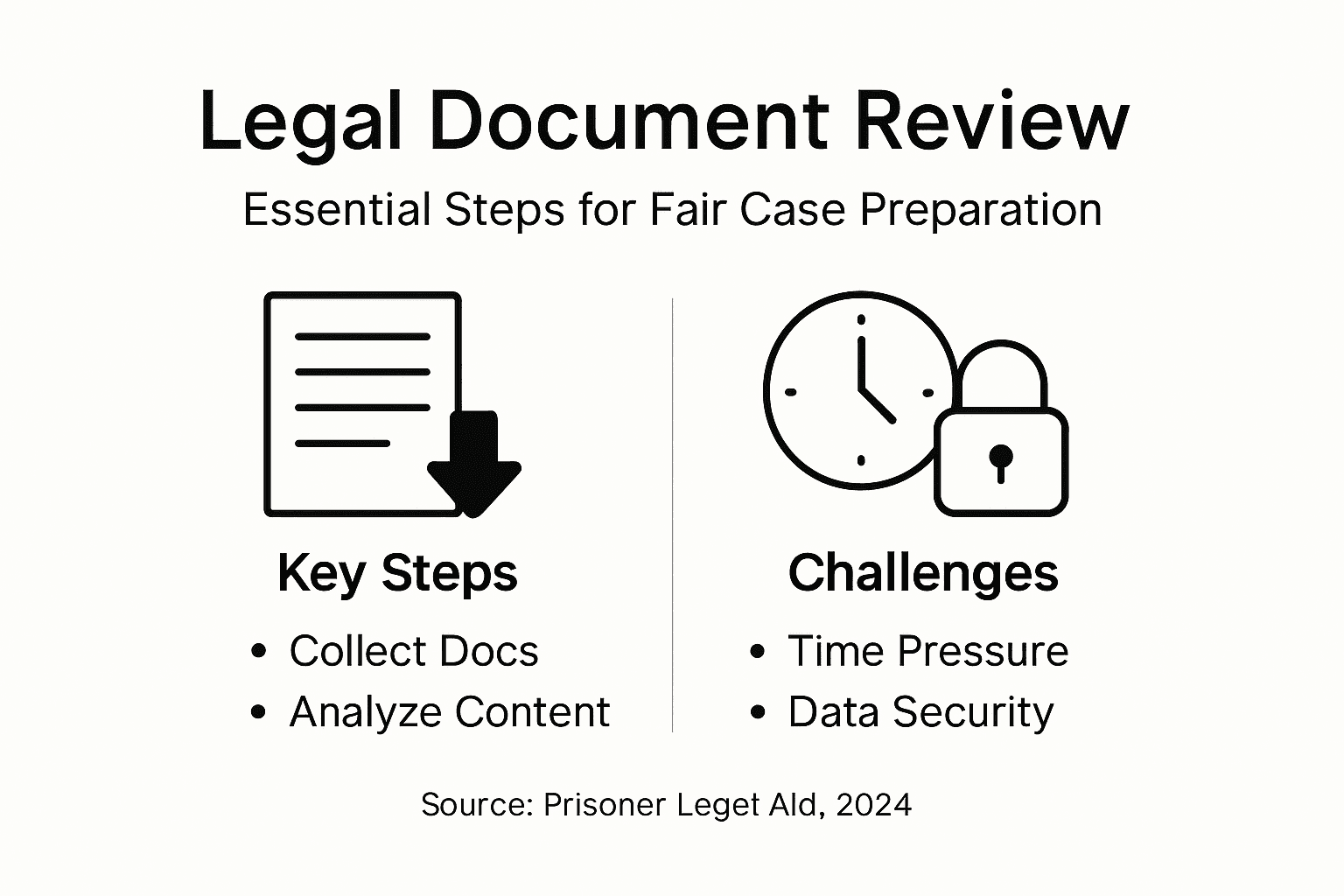
Pro tip: Always create a comprehensive confidentiality tracking system that documents how sensitive information is handled and protected throughout the review process.
Risks, Costs, and Common Pitfalls for Prison Litigants
Prison litigation presents unique challenges that can significantly impact an incarcerated individual’s ability to pursue legal remedies. Prison litigation challenges reveal systemic obstacles that create substantial barriers for individuals seeking justice within the legal system.
Key risks and challenges include:
- Limited Discovery Access: Restricted ability to gather evidence
- Resource Disparities: Inadequate legal support and financial constraints
- Procedural Complexity: Intricate legal filing requirements
- High Dismissal Rates: Increased likelihood of case rejection
Legal barriers for incarcerated litigants are particularly challenging, with the Prison Litigation Reform Act imposing significant hurdles. These obstacles create multiple potential pitfalls for individuals attempting to navigate the legal system:
- Administrative Exhaustion: Mandatory pre-filing administrative procedures
- Filing Restrictions: Limitations on lawsuit submissions
- Financial Barriers: Costs associated with legal documentation
- Procedural Technicalities: Complex legal formatting requirements
The legal system’s complexity can transform a legitimate claim into an unwinnable battle before it even begins.
The financial and emotional toll of these challenges cannot be overstated. Incarcerated individuals must overcome numerous obstacles, including limited access to legal resources, restricted communication channels, and complex procedural requirements that can derail even the most well-intentioned legal efforts.
Pro tip: Meticulously document every step of your legal process, maintaining comprehensive records to counter potential procedural challenges.
Take Control of Your Legal Document Review Process Today
The article highlights the complex challenges of legal document review including confidentiality rules, procedural hurdles, and the critical need for accurate, compliant filings. If you are incarcerated or self-represented, navigating these difficulties alone can feel overwhelming, especially when facing limited resources and strict court standards. You deserve professional help that understands the nuances of relevance review, privilege screening, and maintaining confidentiality as outlined in your case preparation.

At Prisoner Legal Aid, we specialize in preparing and formatting legal documents with precision to meet federal and state court requirements. Our services support you in drafting petitions, civil rights claims, and appellate briefs while protecting your sensitive information. Don’t wait until procedural pitfalls derail your case. Visit Prisoner Legal Aid now to get expert assistance and ensure your legal documents are court-ready with confidentiality and accuracy. Let us help you take the next step toward fairness in your case preparation.
Frequently Asked Questions
What is legal document review?
Legal document review is the systematic examination and analysis of documents to determine their relevance, sensitivity, and potential impact on a legal case. It involves collaboration among legal specialists, paralegals, and technology-driven platforms, not just attorneys.
What are the common misconceptions about document review?
Common misconceptions include the belief that only attorneys can perform document reviews, that it is a straightforward task, that all documents hold equal importance, and that technology can completely replace human judgment in the process.
What types of documents are typically reviewed during legal proceedings?
Documents commonly reviewed include pleadings, contracts, financial records, electronic communications, and internal correspondence. Each type can provide critical evidence or contextual information relevant to the case.
What are the key risks and challenges faced by incarcerated individuals in legal litigation?
Incarcerated individuals face challenges such as limited discovery access, resource disparities, complex procedural requirements, and high dismissal rates, all of which can significantly hinder their ability to pursue legal remedies.