

Starting a legal battle can feel overwhelming when you need to prepare your own documents for United States courts, especially with limited resources. Missing a single form, deadline, or detail might derail your case before it gets a fair hearing. This guide outlines each step of affordable legal document preparation, from gathering essential information to final court filing, empowering you to build strong filings with clear checklists and practical tips.
Table of Contents
- Step 1: Gather Essential Case Information And Materials
- Step 2: Select And Review Applicable Legal Document Templates
- Step 3: Draft Documents And Ensure Procedural Compliance
- Step 4: Format And Proofread For Court Requirements
- Step 5: Verify Completeness And Submit For Client Approval
- Step 6: Finalize And File Legal Documents With The Court
Quick Summary
| Key Point | Explanation |
|---|---|
| 1. Gather Comprehensive Evidence | Document all relevant details to build a solid foundation for your case. Organize information meticulously to enhance effectiveness. |
| 2. Select Appropriate Templates | Choose legal document templates that meet your specific jurisdiction’s requirements. Verify that they are up-to-date and comprehensive to ensure compliance. |
| 3. Draft Legally Sound Documents | Create clear, precise documents that meet procedural requirements. Use consistent formatting and legal language to minimize errors. |
| 4. Thoroughly Proofread Submissions | Conduct detailed proofreading to catch any mistakes or formatting issues. Ensure all court-specific requirements are met to avoid rejection. |
| 5. Collaborate with Clients Effectively | Involve clients in the review process to confirm all documents are accurate and complete. Clear communication fosters trust and prevents misunderstandings. |
Step 1: Gather essential case information and materials
Successfully preparing your legal documents begins with comprehensive information gathering. Your goal in this crucial first step is to collect and organize all relevant details that will form the foundation of your case.
Starting your case preparation requires a systematic approach to collecting information. Efficient case file organization means documenting every critical detail meticulously. Begin by creating a dedicated case folder where you’ll compile all your materials. This folder will become your central repository for key documents and evidence.
The intake process involves collecting several essential categories of information:
- Personal identification details
- Contact information for all involved parties
- Relevant legal documents
- Chronological timeline of events
- Witness contact information
- Financial records related to the case
- Prior legal actions or communications
While gathering materials, focus on maintaining clear, organized records. Each document should be labeled with its date, source, and relevance to your case. Comprehensive legal case intake ensures you don’t overlook any critical information that could impact your legal strategy.
Systematic documentation is your strongest ally in legal document preparation.
Pro tip: Create digital and physical backup copies of all your documents to prevent potential loss or damage.
Step 2: Select and review applicable legal document templates
In this critical step, you’ll identify and carefully evaluate the most appropriate legal document templates for your specific case requirements. Your goal is to find templates that align precisely with your legal needs while ensuring maximum accuracy and compliance.

Selecting the right legal template starts with understanding the nuanced details of your case. Proper legal document preparation requires thoroughly analyzing the transaction type and reviewing state and local regulations. Each template should be meticulously matched to your specific jurisdiction and legal context.
Key considerations when selecting legal document templates include:
- Matching template to specific legal issue
- Verifying jurisdiction-specific requirements
- Assessing template comprehensiveness
- Checking for recent legal updates
- Confirming industry-specific provisions
- Evaluating template language precision
When reviewing potential templates, carefully examine the structural elements and language. Effective legal template selection demands analyzing relevant laws and choosing clear, precise language that communicates your legal intent accurately.
Not all templates are created equal – customize ruthlessly to fit your unique legal scenario.
Pro tip: Always maintain multiple template versions and track changes to ensure you’re working with the most current legal documentation.
Step 3: Draft documents and ensure procedural compliance
In this crucial stage of legal document preparation, you’ll transform your gathered information into precise, court-ready documents that meet stringent procedural requirements. Your objective is to craft clear, legally sound documentation that effectively communicates your legal position.
Drafting legally compliant documents requires meticulous attention to detail and a systematic approach. Developing a consistent drafting strategy helps minimize errors and ensures your documents meet court standards. Each document must reflect the specific procedural rules of your jurisdiction, incorporating precise legal terminology and maintaining a professional, authoritative tone.
Key elements of effective legal document drafting include:
- Maintaining consistent formatting
- Using clear and concise language
- Referencing specific legal statutes
- Avoiding ambiguous or vague statements
- Organizing information logically
- Proofreading for grammatical accuracy
- Ensuring proper citation of sources
Procedural compliance demands more than just accurate content. You must pay close attention to formatting requirements, page margins, font specifications, and filing protocols specific to your court system.
Precision in legal drafting is not a luxury – it’s an absolute necessity.
Pro tip: Create a personal checklist of jurisdiction-specific formatting and procedural requirements to review before finalizing any legal document.
Step 4: Format and proofread for court requirements
In this critical final stage of document preparation, you’ll transform your draft into a polished, court-ready submission that meets the most stringent procedural standards. Your goal is to create a flawless document that reflects professionalism and legal precision.
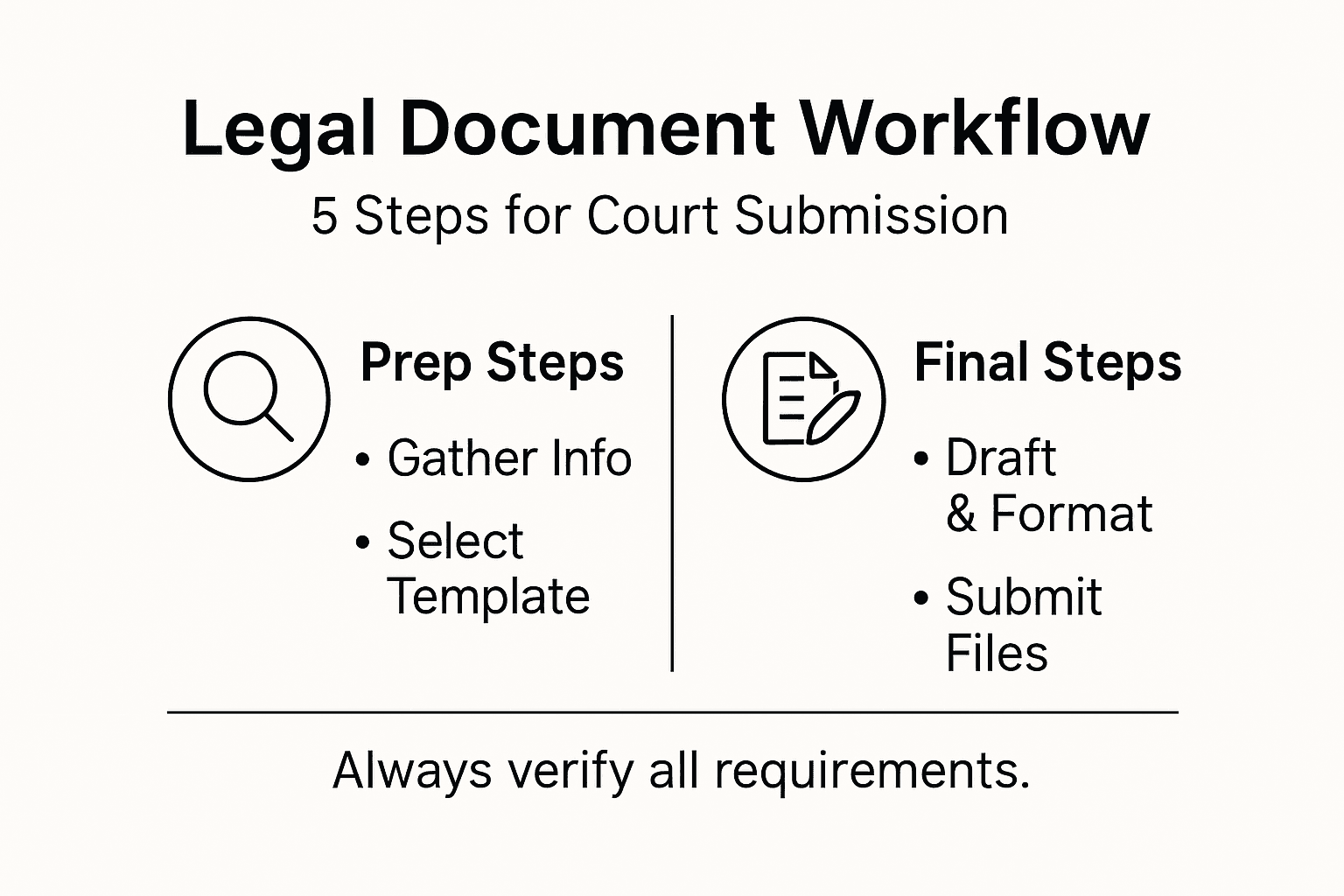
Legal document review requires meticulous attention to every detail. Systematic proofreading is your ultimate defense against potential court rejection. This process goes far beyond simple spell-checking – it involves a comprehensive examination of formatting, content accuracy, and procedural compliance.
Key elements of effective document formatting and proofreading include:
- Verifying correct margin sizes
- Checking font type and size specifications
- Ensuring consistent page numbering
- Confirming proper section headings
- Reviewing citation formats
- Eliminating typographical errors
- Cross-referencing legal citations
- Validating document page count requirements
Precision matters in legal documentation. Even minor formatting errors can compromise your entire submission. Pay special attention to court-specific requirements, which can vary dramatically between jurisdictions.
Small details determine the difference between acceptance and rejection.
Pro tip: Create a personalized formatting checklist specific to your court’s requirements and review it methodically before final submission.
Step 5: Verify completeness and submit for client approval
In this critical final phase, you’ll conduct a comprehensive review of your legal documents and prepare them for client examination. Your objective is to ensure absolute accuracy and secure client confirmation before proceeding to official submission.
Document verification process requires thorough scrutiny of every component. Comprehensive document review involves more than simply checking for errors – it means creating a transparent pathway for client understanding and approval.
Key elements of verification and client submission include:
- Confirming all required sections are complete
- Cross-referencing attached supporting documents
- Verifying all signatures and dates
- Ensuring legal citations are accurate
- Checking financial or numerical data
- Preparing clear explanatory notes
- Creating a summary of key document points
- Identifying potential areas for client questions
Client collaboration is crucial in legal documentation. Sharing drafts allows clients to review, understand, and provide meaningful input. Legal document preparation thrives on transparency and mutual understanding.
Clear communication prevents misunderstandings and builds trust.
Pro tip: Develop a standardized client review template that guides them through key document sections and highlights areas requiring their specific attention.
Step 6: Finalize and file legal documents with the court
In this ultimate stage of your legal document preparation journey, you’ll navigate the critical process of submitting your meticulously crafted documents to the court system. Your goal is to ensure flawless submission that meets all procedural requirements and preserves your legal standing.
Legal case management workflow demands precision and attention to administrative details. Court filing procedures involve more than simply dropping off paperwork – they require strategic navigation of complex institutional protocols.
Essential considerations for court document filing include:
- Confirming current filing deadlines
- Understanding court-specific submission requirements
- Preparing multiple document copies
- Verifying electronic and physical submission protocols
- Tracking proof of filing
- Maintaining comprehensive filing records
- Checking required filing fees
- Ensuring proper document certification
Timely and accurate filing is your legal lifeline. Each submission represents a critical moment in your legal strategy, where procedural correctness can significantly impact your case’s progression.
This overview highlights common errors and prevention strategies at each stage:
| Stage | Typical Error | Prevention Strategy |
|---|---|---|
| Gathering Materials | Missing critical evidence | Use comprehensive intake checklist |
| Template Selection | Template not matching jurisdiction | Verify local legal requirements |
| Drafting | Ambiguous language | Apply clear, concise terminology |
| Formatting | Formatting not court-compliant | Follow court guidelines precisely |
| Verification | Unnoticed data discrepancies | Cross-check all document details |
| Filing | Missed deadlines | Track submission dates systematically |
Here’s how the stages of legal document preparation differ by focus and required skills:
| Stage | Primary Focus | Essential Skills |
|---|---|---|
| Information Gathering | Collect and organize case details | Attention to detail, organizational ability |
| Template Selection | Choose legal document formats | Research, regulatory analysis |
| Document Drafting | Write clear legal documents | Legal writing, procedural knowledge |
| Formatting & Proofreading | Meet court formatting standards | Editing, compliance expertise |
| Verification & Client Review | Ensure accuracy and client approval | Communication, document review |
| Court Filing | Submit documents to court | Administrative precision, time management |
Precision in filing can be the difference between acceptance and rejection.
Pro tip: Create a digital and physical backup of every document immediately after filing to protect against potential administrative complications.
Streamline Your Legal Document Preparation with Expert Assistance
Mastering the detailed workflow of legal document preparation can feel overwhelming, especially when you must gather comprehensive case information, select precise templates, draft flawlessly, and ensure strict procedural compliance. Common challenges often include missing critical evidence, navigating jurisdiction-specific formatting, and confirming accuracy before court filing. These steps demand attention to detail, strong organizational skills, and legal knowledge that many self-represented individuals or incarcerated persons might find difficult to manage alone.
Prisoner Legal Aid understands these hurdles and offers specialized support tailored to your needs. Through our platform, you gain access to professional legal document preparation services focused on drafting, formatting, and submitting court-ready documents like habeas corpus petitions and civil rights claims with guaranteed procedural compliance. We emphasize confidentiality, affordability, and fast turnaround times so you can have confidence in moving your case forward without unnecessary delays.
Don’t let the complexities of legal paperwork hold you back. Visit Prisoner Legal Aid to explore reliable assistance that aligns perfectly with your document preparation workflow. Learn about our streamlined service process and how we can help you avoid common pitfalls by providing expert support at every stage. Take control of your legal journey now and ensure your documents meet all court requirements accurately and on time.
Frequently Asked Questions
How do I gather essential case information for legal document preparation?
To gather essential case information, create a dedicated case folder to compile all relevant details and documents. Focus on collecting personal identification details, contact information for all involved parties, and any relevant legal documents to establish a solid foundation for your case.
What are the criteria for selecting legal document templates?
When selecting legal document templates, ensure they align with your specific legal issue and jurisdiction. Review their comprehensiveness, assess for any recent legal updates, and confirm precise language to communicate your legal intent clearly.
How can I ensure my drafted legal documents comply with court requirements?
To ensure compliance, carefully review your drafted documents against specific procedural rules of your jurisdiction. Maintain consistent formatting, use clear language, and proofread for grammatical accuracy to avoid errors that could hinder acceptance by the court.
What formatting elements should I focus on during the final proofing stage?
During the final proofing stage, verify correct margin sizes, font type and size, page numbering, and citation formats. Addressing these details systematically can prevent common errors that may lead to rejection by the court.
How do I prepare my legal documents for client review before submission?
To prepare for client review, conduct a comprehensive document verification that includes checking for required sections, signatures, and legal citations. Provide clear explanatory notes and a summary of key points to facilitate understanding and collaboration from your client.
What steps should I take after drafting my legal documents to ensure timely filing?
After drafting, confirm filing deadlines and understand the court’s specific submission requirements. Prepare multiple document copies and track proof of filing to ensure that your submission is both timely and complete, which is essential for maintaining legal standing.