
Finding clear legal guidance behind bars can feel impossible when every step is blocked by complicated rules and limited resources. For many incarcerated individuals, understanding how to file habeas corpus petitions or civil rights claims is the first step toward justice. Legal consultation for inmates empowers you with real information about your rights, practical strategies for document preparation, and the confidence to challenge unfair treatment or conditions directly.
Table of Contents
- Defining Legal Consultation for Inmates
- Types of Legal Issues Facing Inmates
- Process of Legal Consultation in Prison
- Inmate Rights and Legal Access
- Barriers to Effective Legal Support
- Costs, Risks, and Alternatives for Inmates
Key Takeaways
| Point | Details |
|---|---|
| Legal Consultation Empowers Inmates | It provides inmates with critical knowledge about their rights and procedural guidance in the prison system. |
| Inmates Retain Constitutional Rights | Even while incarcerated, inmates have fundamental rights, including access to legal resources and protections against cruel punishment. |
| Barriers to Legal Support Are Significant | Communication restrictions and institutional limitations create serious challenges for inmates seeking legal assistance. |
| Alternative Legal Support Options Exist | Resources such as pro bono services and non-profit organizations can help mitigate the costs and risks associated with legal representation. |
Defining Legal Consultation for Inmates
Legal consultation for inmates is a specialized legal support service designed to help incarcerated individuals understand and protect their constitutional rights within the complex prison system. Unlike traditional legal representation, this service focuses on empowering inmates with critical legal knowledge and procedural guidance.
At its core, legal consultation involves providing inmates with comprehensive information about their constitutional rights in prison. These rights encompass several critical areas:
- Access to court systems
- Protection against cruel and unusual punishment
- Right to file grievances
- Freedom of speech and petition
- Protection from discriminatory treatment
The primary objectives of legal consultation for inmates include:
- Educating inmates about their legal rights
- Explaining potential legal remedies
- Assisting with document preparation
- Guiding self-advocacy strategies
- Preventing potential rights violations
Legal consultation serves as a critical bridge between incarcerated individuals and the broader justice system. Professional legal consultants work to ensure inmates can effectively communicate their legal challenges and understand the complex pathways for addressing them.
The following table highlights differences between traditional legal representation and legal consultation for inmates:
| Feature | Traditional Legal Representation | Legal Consultation for Inmates |
|---|---|---|
| Primary Goal | Achieve favorable verdict or settlement | Educate and empower inmates |
| Interaction | Lawyer manages the case directly | Inmate self-advocates with guidance |
| Scope of Support | Full case management | Document preparation and rights advice |
| Outcome Focus | Legal judgment or agreement | Knowledge, self-advocacy skills |
Legal consultation transforms legal barriers into navigable pathways for justice.
Key challenges that legal consultation addresses include helping inmates:
- Understand complex legal terminology
- Identify potential constitutional violations
- Prepare necessary legal documents
- Navigate institutional grievance procedures
- Develop strategic approaches to legal challenges
Pro tip: Always document and record every interaction related to your legal consultation to maintain a clear and verifiable record of communication and advice.
Types of Legal Issues Facing Inmates
Inmates encounter a complex landscape of legal challenges that require specialized understanding and strategic navigation. Constitutional rights in prison represent the foundational framework for addressing these multifaceted legal issues, encompassing a range of critical areas that impact an individual’s daily life and long-term legal standing.
The primary categories of legal issues facing inmates include:
-
Conditions of Confinement
- Overcrowding
- Inadequate medical care
- Sanitation standards
- Physical living conditions
-
Civil Rights Violations
- Discrimination
- Physical or sexual abuse
- Denial of basic human rights
- Unequal treatment
-
Procedural Legal Challenges
- Disciplinary hearings
- Classification disputes
- Parole consideration
- Appeals processes
Constitutional protections play a critical role in addressing these challenges. Inmates retain specific rights even while incarcerated, including protection against cruel and unusual punishment, access to medical care, and the ability to file grievances against institutional misconduct.
Legal challenges in prison are complex battles that require precise understanding and strategic advocacy.
The most prevalent legal issues often revolve around fundamental rights and institutional interactions. These can include challenges related to:
- Medical treatment quality
- Personal safety within correctional facilities
- Religious freedom
- Communication with external support systems
- Fair disciplinary procedures
Understanding these legal issues requires comprehensive knowledge of both institutional policies and constitutional protections. Professional legal consultation becomes crucial in helping inmates effectively articulate and address these complex challenges.
Pro tip: Document every interaction, complaint, and institutional response meticulously to create a strong foundation for potential legal actions.
Process of Legal Consultation in Prison
The process of legal consultation in prison is a carefully structured mechanism designed to protect inmates’ constitutional rights while maintaining institutional security. Legal access and communication protocols form the foundation of this complex interaction between incarcerated individuals and legal support systems.
Typical legal consultation procedures typically involve several key stages:
-
Initial Request
- Identifying specific legal issue
- Submitting formal consultation request
- Scheduling confidential meeting
- Gathering relevant documentation
-
Consultation Methods
- In-person attorney meetings
- Confidential phone consultations
- Written correspondence
- Access to prison law libraries
-
Documentation Preparation
- Reviewing case details
- Drafting legal documents
- Collecting supporting evidence
- Ensuring procedural compliance
Institutional Requirements play a critical role in facilitating legal consultations. Correctional facilities must provide inmates with reasonable opportunities to prepare and pursue legal claims, including access to writing materials, postage, and basic legal resources.
Meaningful legal access is a constitutional obligation, not an optional privilege.
The consultation process involves multiple critical components:
- Confidential communication channels
- Secure document transmission
- Verification of inmate identity
- Institutional security protocols
- Preservation of attorney-client privilege
Professional legal consultants must navigate complex institutional rules while ensuring inmates receive comprehensive support. Strategic communication becomes essential in overcoming potential bureaucratic barriers and protecting individual legal rights.

Pro tip: Maintain meticulous records of all legal interactions and correspondence to establish a clear documentation trail for potential future proceedings.
Inmate Rights and Legal Access
Inmates retain fundamental constitutional protections that extend beyond their incarceration, ensuring basic human rights and legal safeguards within correctional environments. Prisoners’ constitutional rights form a critical framework protecting individuals from institutional abuse and maintaining core legal protections.
The primary categories of inmate legal rights encompass several key areas:
-
First Amendment Rights
- Freedom of speech
- Religious practice
- Access to media
- Communication with external support systems
-
Due Process Protections
- Fair disciplinary hearings
- Grievance submission
- Appeal procedures
- Impartial institutional review
-
Eighth Amendment Safeguards
- Protection from cruel punishment
- Adequate medical care
- Humane living conditions
- Basic physical safety
Constitutional Guarantees mandate that correctional facilities provide meaningful legal access, including essential resources for pursuing legitimate legal claims. This involves supplying law libraries, legal assistance programs, and communication channels that enable inmates to prepare and file important documents.
Legal rights are not suspended upon incarceration but transformed and carefully balanced.
Key components of legal access for inmates include:
- Confidential legal communication
- Access to legal research materials
- Ability to file grievances
- Protection from retaliatory actions
- Opportunity to challenge institutional decisions
The legal system recognizes that inmates maintain fundamental rights to pursue justice, challenge potential violations, and seek remedies through established legal channels. Strategic legal knowledge becomes crucial in navigating these complex institutional environments.
Pro tip: Maintain a comprehensive personal log of all interactions, documenting dates, participants, and specific details to support potential future legal actions.
Barriers to Effective Legal Support
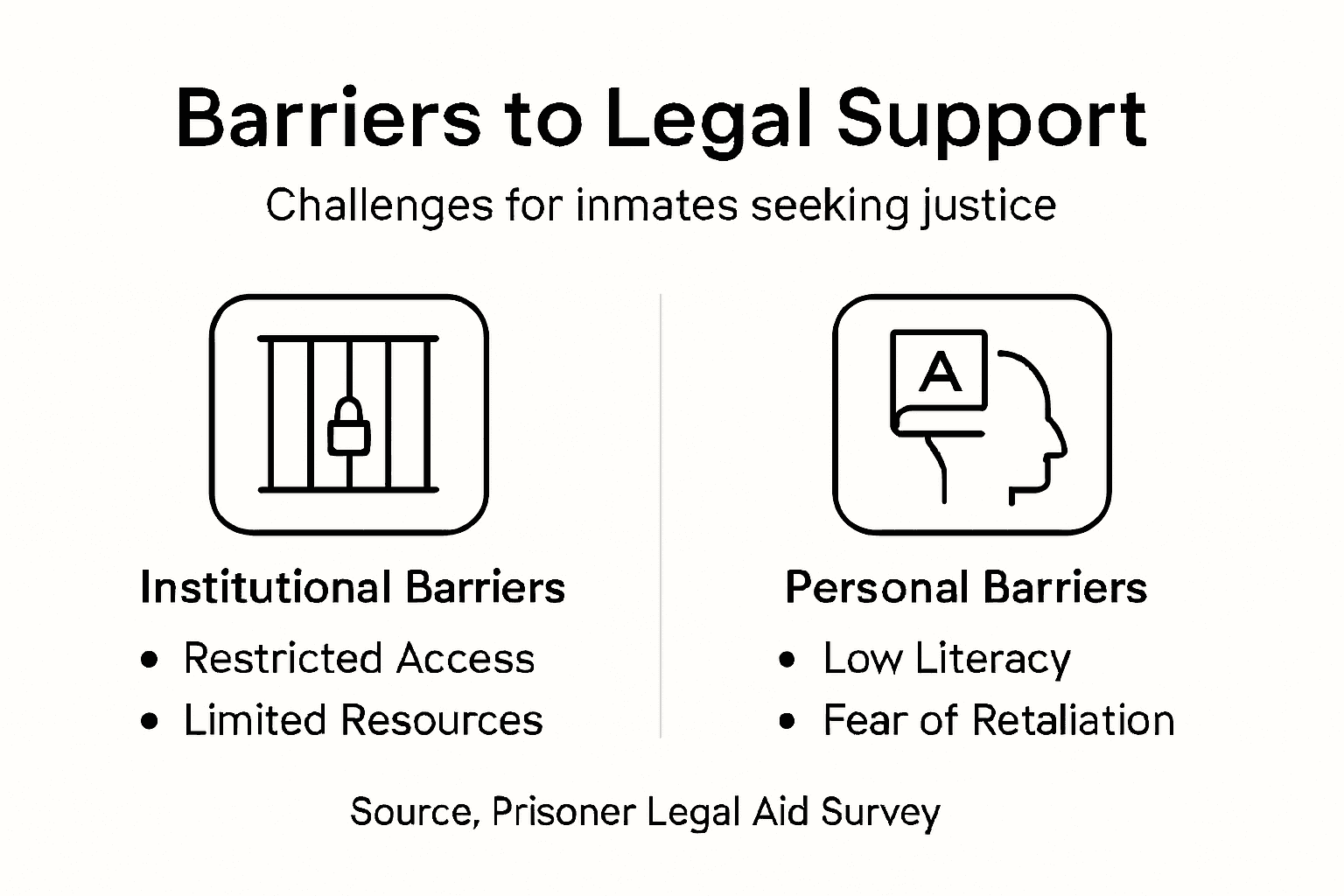
Inmates face numerous complex obstacles that significantly undermine their ability to access meaningful legal support and pursue justice. Systemic legal barriers create substantial challenges for incarcerated individuals seeking to protect their constitutional rights and navigate legal processes.
The primary barriers to effective legal support include:
-
Institutional Communication Restrictions
- Limited phone access
- Monitored communications
- Restricted attorney meetings
- Controlled correspondence
-
Resource Limitations
- Inadequate law library facilities
- Insufficient legal research materials
- Minimal funding for legal assistance
- Understaffed public defender offices
-
Procedural Complications
- Complex filing requirements
- High documentation standards
- Strict time-sensitive deadlines
- Bureaucratic processing delays
Systemic Challenges create significant hurdles for inmates attempting to pursue legal remedies. These barriers often prevent individuals from effectively preparing and presenting their legal claims, ultimately compromising their access to justice.
Institutional barriers transform legal access from a right into an almost insurmountable challenge.
Key structural impediments that undermine legal support include:
- Financial constraints
- Limited confidential communication channels
- Security protocol restrictions
- Complex administrative procedures
- Minimal legal education resources
The intersection of institutional policies and legal constraints creates a challenging environment that disproportionately impacts inmates’ ability to seek fair legal representation and challenge potential rights violations. Strategic legal navigation becomes crucial in overcoming these systemic obstacles.
Pro tip: Document every interaction and communication attempt meticulously, creating a comprehensive record that can support potential future legal challenges.
Costs, Risks, and Alternatives for Inmates
Navigating legal support within the prison system requires careful consideration of financial, personal, and institutional challenges. Legal consultation risks encompass multiple dimensions that inmates must strategically evaluate before pursuing legal actions.
The primary costs and risks associated with legal consultation include:
-
Financial Burdens
- Private attorney fees
- Document preparation costs
- Research material expenses
- Potential court filing charges
-
Institutional Risks
- Potential retaliation
- Disciplinary consequences
- Increased surveillance
- Restricted communication privileges
-
Psychological Challenges
- Emotional stress
- Confrontational interactions
- Extended legal proceedings
- Uncertainty of outcomes
Alternative Legal Support strategies can help mitigate these challenges and provide more accessible paths to legal assistance. These alternatives focus on reducing direct financial costs and institutional risks while maintaining meaningful legal advocacy.
Legal support is not about winning every battle, but navigating complex systems strategically.
Key alternatives for inmates seeking legal support include:
Here is a summary of alternative legal support options and their main advantages:
| Alternative Support | Key Benefit | Example Resource |
|---|---|---|
| Pro bono services | No attorney fees | Legal aid clinics |
| Non-profit organizations | Comprehensive resources | Prisoner Rights Project |
| Self-help manuals | Independent learning | Jailhouse Lawyer’s Handbook |
| Jailhouse lawyers | Peer guidance | Experienced inmates |
| Digital research platforms | Remote legal materials | LexisNexis kiosks |
- Pro bono legal services
- Non-profit legal aid organizations
- Self-help legal manuals
- Jailhouse lawyer consultations
- Digital legal research platforms
Successful navigation of legal challenges requires understanding both the potential risks and available alternatives. Strategic legal planning becomes essential in maximizing support while minimizing potential negative consequences.
Pro tip: Prioritize building a comprehensive documentation trail and seek multiple perspectives before committing to any legal strategy.
Empower Your Legal Rights with Expert Document Preparation
Understanding your constitutional rights and the complexities of legal consultation while incarcerated is just the first step. The challenges of navigating limited communication, intricate filing requirements, and institutional barriers can feel overwhelming. If you need help drafting critical legal documents like habeas corpus petitions or civil rights claims, professional assistance can make all the difference.

Turn confusion into clarity by using Prisoner Legal Aid. Our specialized document preparation services are designed specifically for inmates and self-represented individuals across the United States looking to protect their rights effectively. With affordable fees, confidential service, and quick turnaround times, we help you comply with strict procedural demands and give you a real chance to be heard in federal and state courts. Start empowering yourself today by visiting our main site and explore how our legal consultation and document assistance can support your case planning and submission process.
Frequently Asked Questions
What is legal consultation for inmates?
Legal consultation for inmates is a specialized service that helps incarcerated individuals understand and protect their constitutional rights while navigating the prison system. It focuses on educating inmates about their rights, document preparation, and self-advocacy strategies.
What types of legal issues do inmates commonly face?
Inmates commonly face legal issues related to conditions of confinement, civil rights violations, and procedural legal challenges, including overcrowding, inadequate medical care, and unfair disciplinary hearings.
How can inmates access legal consultation in prison?
Inmates can access legal consultation through initial requests, confidential meetings with legal consultants, written correspondence, and visits to prison law libraries. Correctional facilities are required to provide reasonable access to legal resources.
What are some barriers to effective legal support for inmates?
Barriers to effective legal support for inmates include restricted communication, resource limitations such as inadequate law library facilities, complex filing procedures, and potential retaliation from prison staff for pursuing legal actions.
Recommended
- Blog – Prisoner Legal Aid
- Prisoner Legal Aid – Professional Legal Document Preparation Services
- Prisoner Legal Aid | Federal & Civil Rights Document Preparation
- Prisoner Legal Aid | Federal & Civil Rights Document Preparation
- The Importance of Legal Consultation in Florida Family Law
- Elevating Your Legal Strategy with Effective Trial War Room Setup and TrialTech Support
- Why Staying Silent Is Still the Best Legal Advice in 2025 – Hickory Attorneys for Family Law, Criminal Defense, & Estate Planning | King & Rowe