

Facing a courtroom as a self-represented litigant can feel like you are fighting an uphill battle, especially when your freedom is at stake. Knowing the difference between a claim with legal merit and one dismissed on technicalities can change the outcome of your federal habeas corpus petition. This article breaks down what American courts really look for in meritorious cases, helping you identify and build stronger arguments that stand up to judicial review.
Table of Contents
- Defining Legal Merit In U.S. Litigation
- Types Of Legal Merit In Court Filings
- Core Requirements For Habeas Corpus Petitions
- How Courts Evaluate Legal Merit
- Common Pitfalls In Proving Legal Merit
Key Takeaways
| Point | Details |
|---|---|
| Understanding Legal Merit | Legal merit is the evaluation of a claim’s substantive legal arguments, focusing on its legitimate grounds for judicial consideration. |
| Types of Legal Merit | Courts assess claims through various merit types, including substantive, procedural, evidentiary, and constitutional merit. |
| Habeas Corpus Requirements | Successful habeas corpus petitions must adhere to strict requirements, including demonstrating a valid custody relationship and exhaustion of state remedies. |
| Common Filing Pitfalls | Litigants should avoid procedural deficiencies, evidentiary weaknesses, and legal ambiguities that can undermine their claims. |
Defining Legal Merit in U.S. Litigation
Legal merit represents the fundamental evaluation of a case’s substantive legal arguments, focusing on whether the claim has legitimate grounds for judicial consideration. In the U.S. legal system, merit goes beyond procedural technicalities and examines the core legal substance underlying a dispute.
When courts assess legal merit, they examine several critical components:
- The strength of legal arguments presented
- Factual evidence supporting the claim
- Applicable laws and legal precedents
- Potential for successful resolution through judicial intervention
The concept of cases decided on the merits involves a comprehensive review where judges evaluate the actual legal dispute rather than dismissing it on technical or procedural grounds. This means the court thoroughly reviews the evidence, arguments, and legal standards before rendering a final judgment.
Courts distinguish between meritorious claims and those lacking substantive legal foundation. A meritorious claim demonstrates:
- Clear legal injury or violation
- Substantial evidence supporting the allegations
- Valid legal theories consistent with existing laws
- Potential for meaningful judicial remedy
Moreover, legal merit involves an objective assessment of whether a reasonable judicial system would find legitimate grounds to proceed with the case. This standard ensures that only claims with substantial legal basis move forward through the judicial process.
Judicial Selection and Merit
Interestingly, the concept of merit extends beyond individual cases to judicial appointment processes, where commissions evaluate candidates based on qualifications and professional standards. This broader interpretation underscores the legal system’s commitment to maintaining high-quality judicial decision-making.
Pro tip: When evaluating your legal claim’s potential merit, critically analyze the evidence, legal precedents, and potential judicial interpretation before proceeding with litigation.
Types of Legal Merit in Court Filings
Legal merit in court filings represents a nuanced framework where claims are evaluated based on their substantive legal foundation and potential for judicial resolution. Different types of legal merit emerge depending on the specific context and nature of the legal dispute, each requiring careful analysis and strategic presentation.

Courts typically recognize several distinct categories of legal merit:
Here’s a summary comparing types of legal merit recognized in U.S. court filings:
| Type of Merit | Core Purpose | Typical Evidence Required | Common Examples |
|---|---|---|---|
| Substantive Merit | Establishes actual legal injury or violation | Credible documentary proof | Contract disputes, tort claims |
| Procedural Merit | Fulfills court’s formal requirements | Properly filed legal documents | Meeting filing deadlines, correct forms |
| Evidentiary Merit | Validates claims through admissible evidence | Witness testimony, exhibits | Medical records, expert statements |
| Constitutional Merit | Protects fundamental legal rights | Constitutional arguments | Civil rights, freedom of speech cases |
- Substantive Merit: Claims that demonstrate clear legal injury and substantial evidence
- Procedural Merit: Arguments that comply with formal legal requirements and court protocols
- Evidentiary Merit: Claims supported by credible, admissible evidence
- Constitutional Merit: Arguments grounded in fundamental legal rights and constitutional principles
Legal research and writing plays a critical role in developing compelling legal arguments that showcase these different merit types. Lawyers must strategically analyze fact patterns, identify relevant precedents, and construct persuasive narratives that demonstrate the claim’s legal validity.
The most common types of legal merit in court filings include:
- Constitutional Claims: Challenging government actions that potentially violate fundamental rights
- Civil Rights Petitions: Addressing systemic discrimination or rights violations
- Habeas Corpus Filings: Challenging unlawful detention or imprisonment conditions
- Administrative Appeals: Contesting decisions made by governmental agencies
Understanding legal merit in court proceedings involves recognizing that not all claims possess equal legal weight. Courts rigorously evaluate whether a claim meets the threshold for serious judicial consideration, examining the underlying legal principles, factual support, and potential for meaningful resolution.
Legal merit is not about winning, but about presenting a cogent argument that demonstrates a legitimate legal basis for judicial intervention.
Evaluating Legal Merit
Successful legal filings require a comprehensive approach that goes beyond mere allegation. Attorneys and self-represented litigants must demonstrate:
- Clear articulation of legal theories
- Substantial supporting evidence
- Alignment with existing legal precedents
- Potential for meaningful judicial remedy
Pro tip: Thoroughly document and research every aspect of your legal claim, focusing on presenting clear, concise arguments that directly address the core legal issues.
Core Requirements for Habeas Corpus Petitions
Habeas corpus petitions represent a critical legal mechanism for challenging unlawful imprisonment, providing incarcerated individuals an opportunity to contest their detention through federal court review. These complex legal documents require meticulous preparation and strict adherence to specific procedural requirements that can significantly impact their potential success.
The fundamental requirements for federal habeas corpus involve several critical components:
- Demonstrating a valid custody relationship
- Filing within prescribed statutory timelines
- Exhausting all state court remedies beforehand
- Presenting only claims related to federal constitutional violations
- Limiting challenges to current conviction and sentencing
Courts impose stringent conditions on habeas corpus petitions to ensure they serve their intended purpose of protecting individual rights while maintaining judicial efficiency. Habeas corpus petitions must meet several critical standards:
The chart below contrasts key requirements for successful federal habeas corpus petitions:
| Requirement Category | What It Ensures | Consequence if Unmet |
|---|---|---|
| Timing Restrictions | Claims are filed promptly | Petition likely dismissed |
| Exhaustion of State Remedies | State systems addressed first | Case may not be heard federally |
| Custody Nexus | Direct relevance to imprisonment | Petition not accepted |
| Constitutional Basis | Focus on federal law violations | Claim denied for lack of merit |
- Timing Restrictions: File within one year of direct appeal conclusion
- Exhaustion Requirement: Completely address all claims in state courts first
- Custody Nexus: Demonstrate direct connection to current imprisonment
- Constitutional Basis: Focus exclusively on federal law violations
A successful habeas corpus petition is not about retrying the case, but challenging fundamental legal errors that violated constitutional rights.
Key Documentation Requirements
Successful petitions demand comprehensive documentation that clearly articulates:
- Specific constitutional rights allegedly violated
- Precise legal arguments supporting the claim
- Supporting evidence demonstrating merit
- Clear explanation of why state court remedies were inadequate
Pro tip: Carefully document every procedural step and legal argument, ensuring each claim directly connects to a potential constitutional violation.
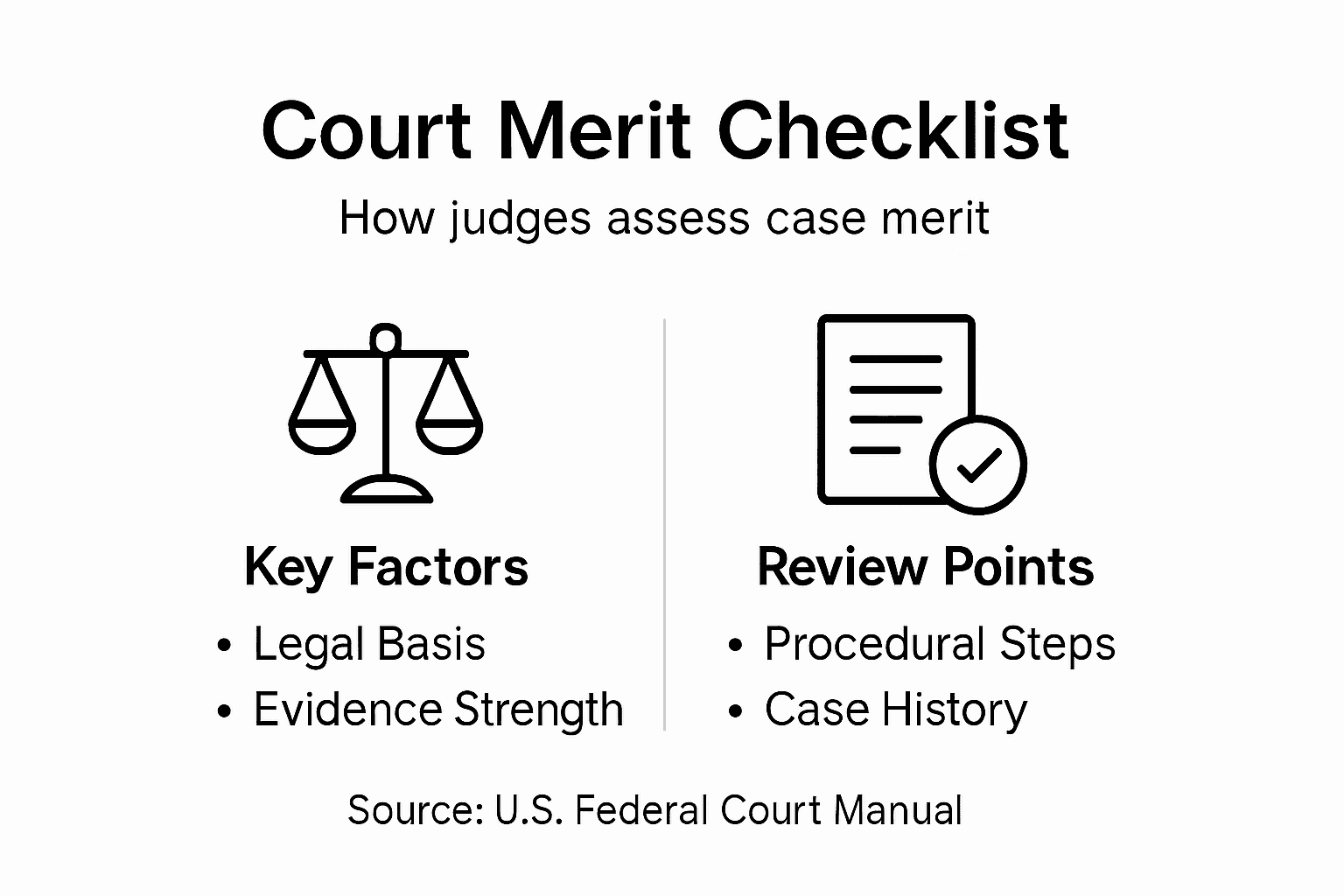
How Courts Evaluate Legal Merit
Legal merit represents the foundational assessment courts use to determine whether a legal claim possesses sufficient substantive grounds for judicial consideration. This rigorous evaluation process goes far beyond simple procedural checkboxes, requiring a comprehensive examination of the underlying legal arguments, factual evidence, and potential constitutional implications.
Courts evaluate legal claims through a multi-layered analytical approach that considers several critical dimensions:
- Strength and coherence of legal arguments
- Quality and admissibility of supporting evidence
- Direct relevance to existing legal standards
- Potential for meaningful judicial remedy
- Alignment with constitutional principles
The judicial assessment of legal merit involves a systematic review that examines multiple interconnected factors:
- Factual Substantiation: Verifying the accuracy and credibility of presented claims
- Legal Precedent: Comparing the current case against established judicial interpretations
- Constitutional Alignment: Assessing potential violations of fundamental rights
- Procedural Compliance: Ensuring proper legal framework and filing requirements
Legal merit is not merely about winning, but about presenting a legitimate and well-supported legal argument that warrants judicial attention.
Comprehensive Merit Evaluation
Courts conduct a nuanced judicial merit assessment that balances multiple considerations:
- Objective analysis of legal arguments
- Rigorous examination of evidentiary support
- Impartial review of potential legal remedies
- Consideration of broader systemic implications
Pro tip: Focus on developing clear, well-documented legal arguments that demonstrate a direct connection between your claims and specific legal or constitutional principles.
Common Pitfalls in Proving Legal Merit
Legal merit demands precision and strategic preparation, with even minor procedural missteps potentially derailing an otherwise substantive legal claim. Incarcerated individuals and self-represented litigants must navigate a complex landscape of legal requirements that can quickly undermine their judicial arguments.
Understanding manifest lack of legal merit involves recognizing the critical errors that can compromise a legal claim:
- Insufficient factual documentation
- Inadequate legal reasoning
- Failure to cite specific constitutional violations
- Incomplete exhaustion of state court remedies
- Presenting arguments outside statutory limitations
Courts are particularly vigilant about identifying claims that do not meet fundamental legal standards. The most common pitfalls include:
- Procedural Deficiencies: Missing critical filing deadlines
- Evidentiary Weakness: Lacking substantive supporting documentation
- Legal Ambiguity: Failing to clearly articulate specific legal violations
- Jurisdictional Errors: Presenting claims in inappropriate legal forums
Judicial systems are designed to filter out claims that lack substantive legal foundation, making precision and clarity paramount.
Avoiding Procedural Traps
Certificate of merit requirements highlight the importance of technical compliance in legal filings. Specific areas where litigants frequently stumble include:
- Improper documentation formatting
- Incomplete affidavit submissions
- Vague or generalized legal arguments
- Failure to reference specific legal precedents
- Neglecting state-specific procedural requirements
Pro tip: Meticulously review every aspect of your legal filing, treating each document as though it will be scrutinized under a microscope by experienced judicial professionals.
Make Your Legal Arguments Count with Expert Document Preparation
Understanding how courts evaluate legal merit is crucial when challenging complex issues like habeas corpus petitions or civil rights claims. This article highlights the importance of clear legal theory, procedural compliance, and strong evidentiary support to avoid common pitfalls that can derail your case. For incarcerated and self-represented individuals, navigating these demanding standards alone can feel overwhelming and risky.

At Prisoner Legal Aid, we specialize in preparing precise, court-ready legal documents that emphasize your claim’s merit and procedural strength. Whether you need help drafting a habeas corpus petition or assembling civil rights claims, we ensure your filings meet strict judicial requirements with confidentiality and quick turnaround. Don’t let procedural errors or unclear arguments stand between you and justice. Take control of your case now by visiting our legal document preparation services and start building a winning legal foundation today.
Frequently Asked Questions
What does legal merit mean in a court case?
Legal merit refers to the substantive evaluation of a case’s arguments and evidence, determining if there are legitimate grounds for judicial consideration.
How do courts evaluate the merit of a legal claim?
Courts assess legal merit by examining the strength of legal arguments, supporting factual evidence, applicable laws, and the potential for a successful resolution through judicial intervention.
What are the types of legal merit that can be considered in court filings?
The main types of legal merit include substantive merit, procedural merit, evidentiary merit, and constitutional merit, each focusing on different aspects of the claims being presented.
What are common pitfalls in proving legal merit in court?
Common pitfalls include procedural deficiencies, insufficient evidence, vague legal reasoning, and failing to clearly articulate specific legal violations.