
Facing legal barriers inside an American prison can feel overwhelming, especially when you want to challenge a policy or a rights violation on your own. Understanding legal standing is crucial before you file in federal court. Courts require proof of a concrete, personal injury directly caused by the defendant and that the court can help fix the harm. With the right knowledge and documentation, you can present a legitimate case that meets strict constitutional requirements.
Table of Contents
- Defining Legal Standing in Federal Courts
- Essential Elements of Legal Standing Tests
- Types of Standing and Key Distinctions
- How Prisoners Establish Standing for Claims
- Consequences of Failing the Standing Requirement
Key Takeaways
| Point | Details |
|---|---|
| Legal Standing Requirement | Plaintiffs must demonstrate a concrete injury, causation, and redressability to establish standing in federal court. |
| Categories of Standing | Different types of standing, including individual, third-party, and organizational, each have specific requirements for eligibility. |
| Prisoners’ Standing Challenges | Incarcerated individuals face unique challenges in proving standing, necessitating precise documentation of constitutional injuries and administrative responses. |
| Consequences of Lacking Standing | Failing to establish legal standing results in immediate case dismissal and can impact future legal filings significantly. |
Defining Legal Standing in Federal Courts
Legal standing is a complex yet fundamental constitutional concept that determines whether an individual can initiate a lawsuit in federal court. At its core, legal standing requires a plaintiff to demonstrate a concrete, personal stake in the legal controversy that goes beyond general grievances.
Under the U.S. Constitution’s Article III cases and controversies clause, federal courts can only hear disputes where the plaintiff has suffered a specific, tangible injury. This constitutional requirement serves several critical purposes:
- Limits judicial power and prevents courts from addressing abstract legal questions
- Ensures only genuine disputes with real-world consequences enter the judicial system
- Protects defendants from frivolous or generalized legal challenges
- Maintains separation of powers by preventing courts from acting like legislative bodies
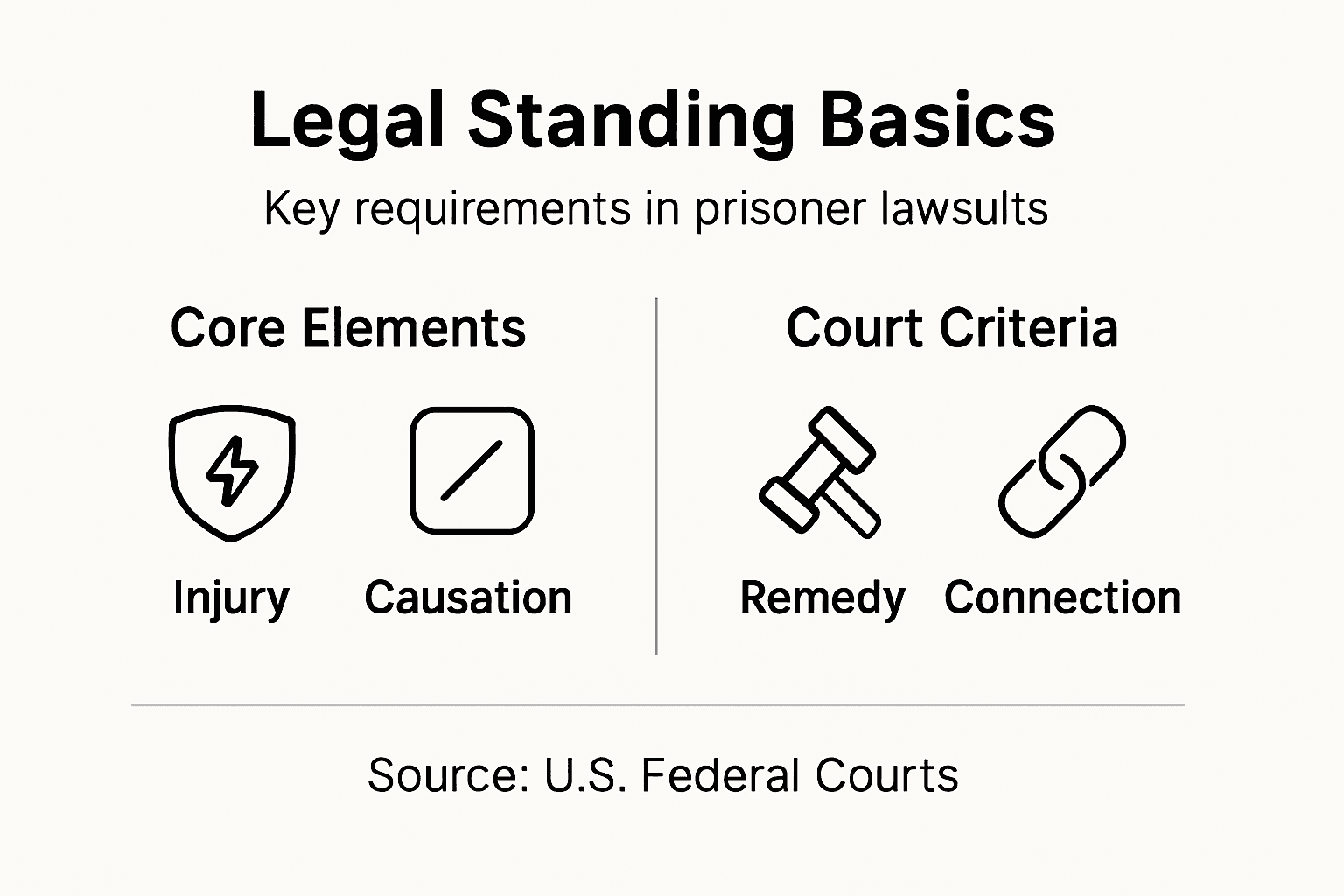
To establish legal standing, a plaintiff must prove three essential elements:
Here’s a summary of core standing requirements and how they function:
| Requirement | Purpose in Court | Example of Satisfying This |
|---|---|---|
| Actual Injury | Ensures real, concrete stakes | Plaintiff shows specific financial loss |
| Causation | Connects harm to defendant | Defendant’s actions directly led to plaintiff’s loss |
| Redressability | Ensures court can help | Court’s ruling will fix or address the harm |
- Actual Injury: A concrete, particularized harm that is real and specific
- Causation: Clear evidence that the defendant directly caused the injury
- Redressability: A reasonable expectation that the court can provide meaningful relief
Federal courts rigorously enforce these standing requirements to maintain the integrity of the judicial process. Constitutional limitations prevent judicial overreach by ensuring that only legitimate controversies receive judicial attention.

Pro tip: When preparing a federal court filing, meticulously document your specific injury and its direct connection to the defendant to demonstrate clear legal standing.
Essential Elements of Legal Standing Tests
The legal standing test is a rigorous constitutional framework that determines whether an individual has the legal right to bring a lawsuit in federal court. Classic standing requirements originated from landmark Supreme Court cases, most notably the Lujan v. Defenders of Wildlife decision, which established a comprehensive three-part examination for judicial review.
To successfully demonstrate legal standing, plaintiffs must prove three interconnected elements that validate the legitimacy of their legal claim:
-
Concrete and Particularized Injury
- Must be specific to the individual
- Cannot be hypothetical or speculative
- Represents a real, tangible harm
-
Causal Connection
- Direct link between plaintiff’s injury and defendant’s actions
- Injury must result from the challenged conduct
- Clear evidence of direct responsibility
-
Redressability
- Court must be able to provide meaningful relief
- Potential judicial decision should effectively remedy the harm
- Likelihood of resolving the underlying injury
The standing test ensures that federal courts address genuine controversies with actual consequences, not theoretical legal disputes.
Legal clarity guidelines emphasize that each element must be substantively proven. Courts meticulously evaluate these requirements to prevent unnecessary litigation and maintain the judicial system’s integrity.
Each component of the standing test serves a critical constitutional purpose. By requiring plaintiffs to demonstrate a personal, concrete stake in the legal controversy, the federal judiciary limits its own power and prevents judicial overreach into legislative domains.
Pro tip: Document every specific detail of your injury, its direct cause, and potential judicial remedy to strengthen your legal standing argument.
Types of Standing and Key Distinctions
Legal standing encompasses several nuanced categories that determine an individual’s ability to bring a lawsuit in federal court. Third-party standing doctrine represents one of the most complex and intriguing areas of judicial interpretation, providing unique pathways for legal representation.
Federal courts recognize multiple types of standing, each with distinct characteristics and constitutional requirements:
This table distinguishes federal standing types and who they protect:
| Standing Type | Who Can Sue | Typical Use Case |
|---|---|---|
| Individual Standing | Injured individual | Personal civil rights violations |
| Third-Party Standing | Other representing party | Parents suing for children’s rights |
| Organizational Standing | Groups or non-profits | Advocacy groups fighting policies |
-
Individual Standing
- Direct personal injury or harm
- Plaintiff represents their own legal interests
- Most straightforward standing category
-
Third-Party Standing
- Plaintiff asserts rights of another person
- Requires demonstrating:
- Close relationship with rights holder
- Significant barriers preventing direct litigation
- Compelling legal or practical justification
-
Organizational Standing
- Nonprofit or institutional entities pursue legal claims
- Must show organizational injury
- Represents collective interests of members
Federal court jurisdictions further distinguish standing based on specific legal domains such as:
-
Federal Question Jurisdiction
- Cases involving constitutional or federal law interpretations
- Standing determined by specific statutory requirements
-
Diversity Jurisdiction
- Disputes between citizens of different states
- Unique standing considerations based on state residency
Standing categories are not merely technical distinctions but fundamental constitutional safeguards protecting judicial integrity.
Understanding these standing types is crucial for navigating the complex landscape of federal litigation. Each category requires careful analysis of the plaintiff’s relationship to the legal controversy and their capacity to represent specific interests.
Pro tip: Carefully document your precise legal relationship to the controversy and potential injuries to strengthen your standing argument in federal court.
How Prisoners Establish Standing for Claims
Legal standing for incarcerated individuals represents a unique and challenging legal landscape. Prisoners’ constitutional rights form the critical foundation for establishing valid legal claims in federal courts, requiring careful documentation and strategic presentation of injuries.
To successfully establish standing, prisoners must navigate complex legal requirements by demonstrating several key elements:
-
Personal Constitutional Injury
- Direct violation of specific constitutional rights
- Concrete and particularized harm
- Injury must be beyond generalized prison conditions
-
Administrative Exhaustion
- Complete internal grievance procedures
- Document all administrative steps taken
- Prove systematic denial of relief through institutional channels
-
Specific Harm Documentation
- Precise descriptions of rights violations
- Medical records
- Witness statements
- Institutional documentation
Inmates’ legal rights typically encompass protection against constitutional violations, including:
-
Eighth Amendment Claims
- Protection from cruel and unusual punishment
- Challenging medical neglect
- Addressing unsafe living conditions
-
First Amendment Challenges
- Freedom of speech
- Religious practice restrictions
- Mail and communication censorship
Constitutional standing requires more than mere grievance—it demands demonstrable, specific injury directly linked to institutional actions.
Successful standing claims demand meticulous preparation. Prisoners must transform general complaints into legally recognizable injuries with clear causal connections to institutional policies or individual actions.
Pro tip: Maintain comprehensive, chronological documentation of every interaction, incident, and institutional response to strengthen your legal standing argument.
Consequences of Failing the Standing Requirement
Legal standing failure represents a critical procedural barrier that can completely derail a prisoner’s judicial pursuit of justice. Federal court dismissal rules create significant obstacles for plaintiffs who cannot demonstrate precise legal requirements.
When prisoners fail to establish standing, multiple consequential outcomes emerge:
-
Immediate Case Dismissal
- Court refuses to hear substantive arguments
- No review of underlying constitutional claims
- Permanent procedural barrier to that specific legal action
-
Potential Future Filing Limitations
- May create precedent discouraging similar claims
- Can impact credibility of subsequent legal filings
- Potential administrative consequences within institutional systems
Judicial review constraints fundamentally protect the court’s constitutional role by preventing:
-
Hypothetical Legal Challenges
- Blocking generalized grievances
- Limiting speculative legal theories
- Ensuring concrete, specific injuries
-
Unnecessary Judicial Intervention
- Preventing courts from addressing political questions
- Maintaining separation of governmental powers
- Conserving judicial resources
Standing requirements are not mere technicalities but fundamental constitutional safeguards protecting the integrity of the judicial system.
Prisoners must understand that failing to meet standing requirements means their substantive legal arguments will never be heard. The dismissal occurs before any consideration of the actual merits of their case, making precise documentation and legal strategy absolutely critical.
Pro tip: Meticulously document every specific injury, maintaining detailed records that directly link your personal harm to institutional actions to strengthen your standing argument.
Strengthen Your Legal Standing with Expert Document Preparation
Legal standing is a crucial hurdle in prisoner court cases. Without proving a specific personal injury, a direct cause, and a tangible remedy, your case may be dismissed before it is even heard. If you are struggling with meeting these strict federal standing requirements, it can feel overwhelming and isolating. Our platform understands the challenge of clearly documenting your constitutional injury and showing how a court can provide relief.

Take control of your legal journey today by using Prisoner Legal Aid’s professional document preparation services. We specialize in drafting and formatting compliant petitions and claims tailored to your unique situation. From habeas corpus petitions to civil rights claims, our affordable and confidential assistance helps ensure your filings meet court standards and strengthen your standing arguments. Visit Prisoner Legal Aid now to get started and protect your rights effectively.
Frequently Asked Questions
What is legal standing for prisoners in court cases?
Legal standing for prisoners refers to their ability to demonstrate a concrete injury related to a constitutional violation, allowing them to bring a lawsuit in federal court.
What are the key elements required to establish legal standing for incarcerated individuals?
To establish legal standing, prisoners must prove personal constitutional injury, exhaust administrative remedies, and provide specific documentation of the harm suffered.
How does failing to meet standing requirements affect a prisoner’s case?
Failing to meet standing requirements can lead to immediate dismissal of the case, preventing any review of the underlying claims, and may impact future legal actions.
What types of constitutional claims can prisoners assert in federal court?
Prisoners can assert claims related to violations of their rights under the Eighth Amendment, such as cruel and unusual punishment, as well as First Amendment claims regarding freedom of speech and religious practice.
Recommended
- Blog – Prisoner Legal Aid
- Prisoner Legal Aid – Professional Legal Document Preparation Services
- Prisoner Legal Aid | Federal & Civil Rights Document Preparation
- Prisoner Legal Aid | Federal & Civil Rights Document Preparation
- Elevating Your Legal Strategy with Effective Trial War Room Setup and TrialTech Support