

Submitting a legal document that gets accepted on the first try can feel like a major victory for anyone facing the courts. For many incarcerated people, understanding the strict rules of court formatting is the first real step toward getting your voice heard. Proper formatting is a requirement, not a suggestion, and courts will reject filings that do not meet their standards. This guide helps break down the core formatting rules and provides the practical steps needed to ensure your documents meet both federal and state court guidelines.
Table of Contents
- Defining Legal Document Formatting Standards
- Types of Documents and Formatting Rules
- How Proper Formatting Affects Court Outcomes
- Court Compliance and Rejection Risks
- Avoiding Common Formatting Mistakes
Key Takeaways
| Point | Details |
|---|---|
| Importance of Formatting | Strict adherence to legal document formatting can prevent automatic rejection by courts and signifies professionalism. |
| Document Type Specifics | Different categories of legal documents have unique formatting requirements that must be followed meticulously. |
| Court Compliance Risks | Non-compliance with formatting standards can lead to case delays, financial penalties, and negative judicial perceptions. |
| Common Formatting Mistakes | Frequent errors such as inconsistent font usage and improper margins undermine document credibility and should be avoided. |
Defining Legal Document Formatting Standards
Legal document formatting is a complex system of rules and standards that govern how legal documents are structured, presented, and submitted across various court systems. Compliance with court formatting guidelines is not just a bureaucratic requirement but a critical aspect of legal communication.
Courts establish precise formatting requirements to ensure documents are readable, professional, and consistent. These standards typically include specific guidelines for:
- Font selection: Usually Times New Roman or Arial, 12-point size
- Line spacing: Double spacing for most legal documents
- Margin dimensions: Standard 1-inch margins on all sides
- Page numbering: Consecutive numbering in bottom right or top right corner
- Header information: Case name, court jurisdiction, filing party details
Beyond aesthetic considerations, proper formatting serves multiple critical functions. Federal document drafting rules emphasize that formatting impacts document clarity, legal interpretability, and overall professional presentation. Incorrect formatting can lead to automatic document rejection, potentially derailing important legal proceedings.
Professional legal document formatting requires meticulous attention to detail and understanding of jurisdiction-specific requirements. Each court system may have unique nuances, making it essential to research and follow their specific guidelines precisely.
Pro tip: Always request and review the specific formatting guidelines for your particular court jurisdiction before submitting any legal documents.
Types of Documents and Formatting Rules
Legal documents encompass a diverse range of written materials, each with unique formatting requirements designed to ensure clarity, professionalism, and legal compliance. Legal form variations demonstrate the complexity of document-specific formatting standards that must be carefully navigated.
The primary categories of legal documents typically include:
- Court Pleadings: Motions, complaints, briefs, and petitions
- Transactional Documents: Contracts, agreements, leases, wills
- Administrative Forms: Government applications, regulatory filings
- Litigation Documents: Depositions, affidavits, discovery requests
- Appellate Submissions: Legal briefs, case summaries, record excerpts
Legal document formatting standards require meticulous attention to specific elements that vary across document types. Each category demands unique formatting considerations, such as specific margin requirements, citation styles, and structural elements that align with judicial expectations.
To better understand common legal document types and their unique formatting priorities, compare the following summary:
| Document Type | Formatting Priority | Typical Submission Challenge |
|---|---|---|
| Court Pleadings | Precision in citations | Adhering to strict court standards |
| Transactional Forms | Clear party identification | Complex clause integration |
| Administrative Forms | Accurate completion of fields | Navigating government terminology |
| Appellate Submissions | Structured argument layout | Meeting specialized pagination |
Court jurisdictions often have nuanced rules for document presentation. Some require strict formatting like precise font sizes, while others mandate specific header information or pagination styles. Understanding these subtle differences is crucial for preventing document rejection and ensuring professional legal communication.
Precision in document formatting can mean the difference between a document being accepted or immediately dismissed by the court.
Pro tip: Always obtain and carefully review the specific formatting guidelines for your particular document type and court jurisdiction before finalizing your submission.
How Proper Formatting Affects Court Outcomes
Proper document formatting can dramatically influence judicial perception and potentially impact legal case outcomes. While formatting might seem like a trivial administrative detail, it represents a critical component of professional legal communication that directly affects how judges and court personnel interpret submitted materials.
The consequences of poor formatting can be substantial and multifaceted:
- Document Rejection: Immediate dismissal of submissions due to technical errors
- Reduced Credibility: Perception of unprofessionalism or lack of attention to detail
- Increased Processing Time: Additional administrative review and potential delays
- Negative Judicial Perception: Subtle bias against poorly presented arguments
- Potential Case Prejudice: Unintentional undermining of legal arguments
Court systems consistently emphasize the importance of precise document presentation. Judges and court clerks process numerous documents daily, and those that demonstrate clear, consistent, and professional formatting are more likely to receive favorable initial attention. A well-formatted document signals respect for the court’s time and processes, potentially creating a more receptive environment for the legal arguments presented.
Here’s a quick comparison of outcomes influenced by proper versus improper formatting in legal documents:
| Formatting Quality | Court Response | Potential Legal Effect |
|---|---|---|
| Proper Formatting | Accepted without delay | Enhanced credibility and clarity |
| Improper Formatting | Risk of immediate rejection | Negative bias, possible sanctions |
Formatting is not just about aesthetics; it’s a form of professional communication that speaks volumes about the care and competence behind the legal submission.
Pro tip: Create a personal formatting checklist that includes all jurisdiction-specific requirements to ensure consistent, professional document preparation.
Court Compliance and Rejection Risks
Legal document submission protocols involve intricate compliance requirements that can significantly impact case proceedings. Courts maintain stringent standards designed to ensure procedural integrity, professionalism, and systematic document management across various legal jurisdictions.
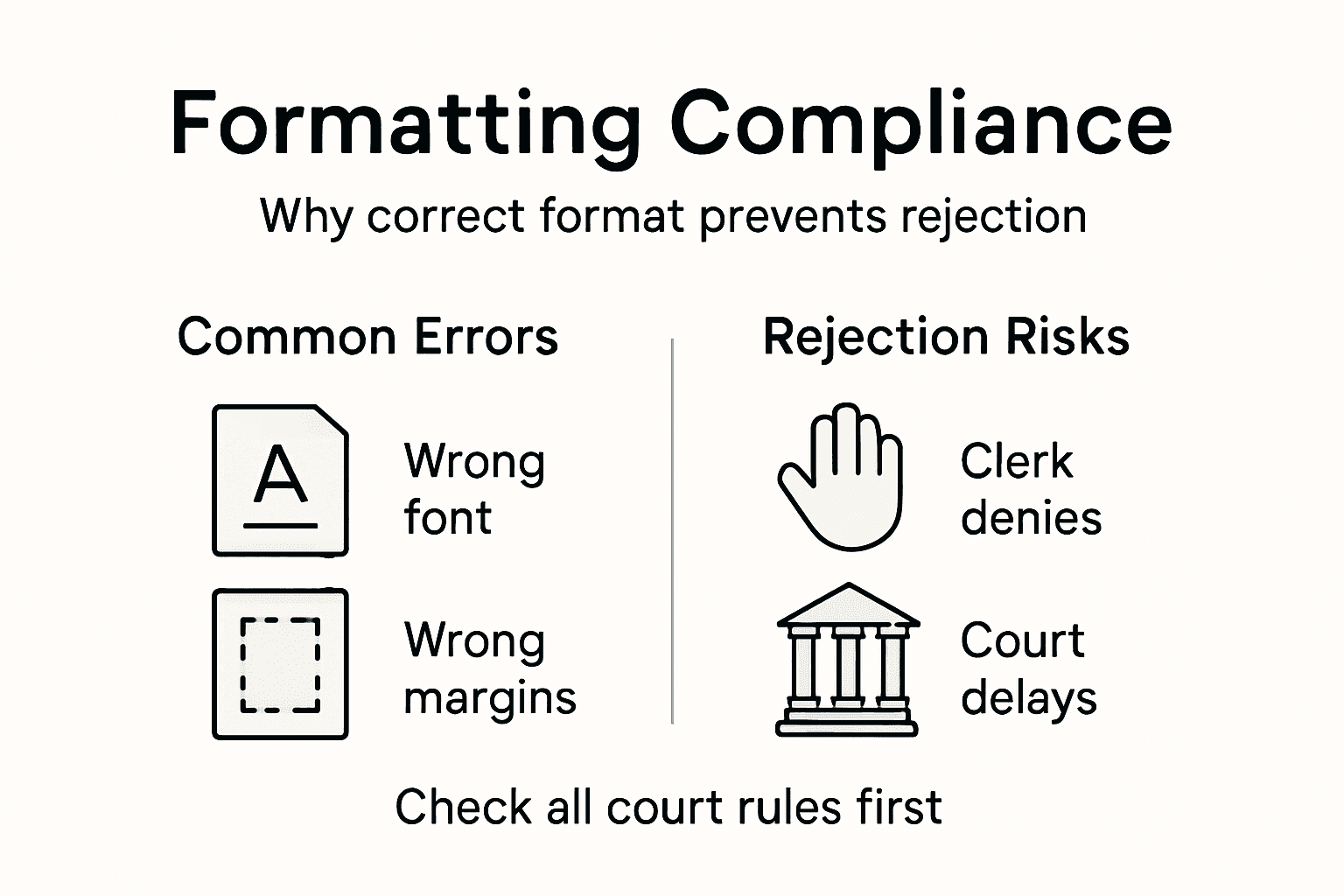
The primary risks associated with non-compliance include:
- Automatic Document Rejection: Immediate dismissal without review
- Case Timeline Disruption: Potential delays in legal proceedings
- Financial Penalties: Additional court fees or sanctions
- Procedural Disadvantages: Potential negative interpretations by judicial personnel
- Potential Case Prejudice: Unintentional undermining of legal arguments
Federal privacy protection rules underscore the complexity of court document submissions. These regulations mandate specific formatting and content guidelines, particularly regarding sensitive information redaction. Courts have developed sophisticated mechanisms to enforce compliance, reflecting the critical nature of procedural adherence in maintaining judicial system efficiency.
Non-compliance is not merely an administrative error, but a potential strategic misstep that can compromise legal objectives.
Pro tip: Develop a comprehensive compliance checklist specific to your court jurisdiction to minimize rejection risks and ensure document accuracy.
Avoiding Common Formatting Mistakes
Legal document formatting standards reveal numerous pitfalls that can compromise document professionalism and court acceptance. Understanding these common errors is crucial for creating legally compliant and visually precise submissions.
The most frequent formatting mistakes include:
- Inconsistent Font Usage: Mixing multiple font styles or sizes within the same document
- Improper Margin Settings: Deviating from standard 1-inch margins
- Incorrect Line Spacing: Failing to use required double spacing
- Pagination Errors: Inconsistent or missing page numbers
- Inadequate Heading Structure: Unorganized or poorly defined document sections
Legal writing structure techniques emphasize the importance of consistent formatting as a critical communication tool. Courts view document presentation as a reflection of legal professionalism, with formatting errors potentially signaling a lack of attention to detail or fundamental legal competence.
Precision in formatting is not optional; it is a fundamental requirement of effective legal communication.
Pro tip: Create a personal formatting template that adheres to your specific court jurisdiction’s guidelines to minimize errors and ensure consistent document quality.
Ensure Your Legal Documents Meet Court Standards with Expert Help
Formatting legal documents correctly is more than just a rule to follow. It is a crucial step that affects whether your submission is accepted, how judges perceive your case, and ultimately the success of your legal matter. If you are facing challenges with strict court formatting requirements, margin settings, citation precision, or managing complex document structures, you are not alone. These are common issues that can delay your case or even lead to rejection, causing unnecessary frustration and risk.
At Prisoner Legal Aid, we specialize in assisting incarcerated and self-represented individuals across the United States in preparing professional, court-ready legal documents. Our services focus on drafting, formatting, and submitting a wide range of filings including habeas corpus petitions and appellate briefs with absolute attention to jurisdiction-specific rules. Don’t let formatting errors hold your case back. Visit our landing page to learn how we can help you meet court compliance and improve the chances of your documents being accepted on the first try. Take control now and protect your legal rights with perfectly formatted documents you can trust.
Frequently Asked Questions
What are the key formatting requirements for legal documents?
Legal document formatting typically includes guidelines for font selection (usually Times New Roman or Arial, 12-point size), line spacing (double spacing), margin dimensions (standard 1-inch margins), page numbering, and header information.
Why is proper legal document formatting important?
Proper formatting is crucial because it affects document clarity, credibility, and the likelihood of acceptance by the court. Poorly formatted documents can face rejection or may lead to a negative perception by judicial personnel.
What are some common formatting mistakes to avoid in legal documents?
Common mistakes include inconsistent font usage, improper margin settings, incorrect line spacing, pagination errors, and inadequate heading structure. Each of these can compromise the professionalism and acceptance of the document.
How can I ensure compliance with court formatting requirements?
To ensure compliance, always request and review the specific formatting guidelines for your court jurisdiction. Developing a comprehensive compliance checklist can also help minimize risks of rejection and ensure accuracy.
Recommended
- Prisoner Legal Aid – Professional Legal Document Preparation Services
- Prisoner Legal Aid | Federal & Civil Rights Document Preparation
- Prisoner Legal Aid | Federal & Civil Rights Document Preparation
- Blog – Prisoner Legal Aid
- The Role of Notary Public Seals and Stamps in Documentation – My Mobile Notary